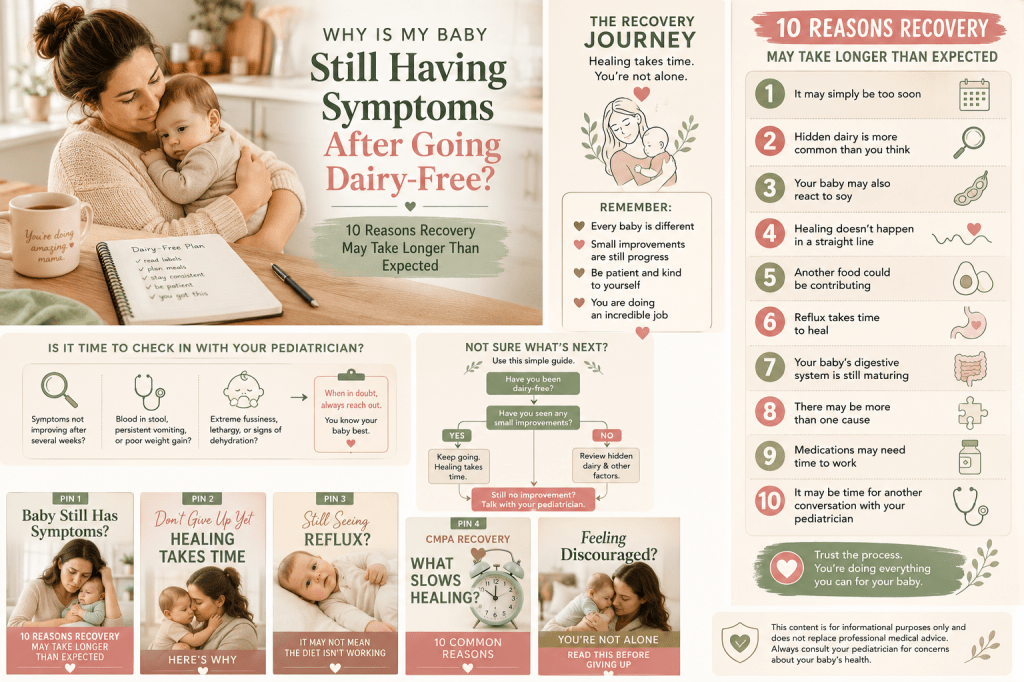
Why Is My Baby Still Having Symptoms After Going Dairy-Free? (10 Reasons Recovery May Take Longer Than Expected)
Quick Answer
If your baby still has symptoms after you’ve eliminated dairy from your diet, it doesn’t necessarily mean the diet isn’t working. Healing from cow’s milk protein allergy (CMPA) often takes time, and several factors—including hidden dairy, soy sensitivity, gut healing, or even an unrelated condition—can delay improvement. Understanding what to expect can help you know when to stay the course and when it’s time to speak with your pediatrician.
“I’ve Been Dairy-Free…So Why Isn’t My Baby Better?”
Few things are more discouraging than committing to a dairy-free diet, checking every ingredient label, giving up favorite foods, and then looking at your baby a week—or even several weeks—later wondering why they’re still uncomfortable.
Maybe the reflux is still happening. Maybe there’s still mucus in the diaper. Perhaps your baby is still arching their back during feeds or waking every hour at night. If you’re feeling frustrated, you’re not alone. This is one of the most common questions parents ask after starting a dairy-free breastfeeding diet. The encouraging news is that a slower recovery doesn’t automatically mean you’ve failed or that dairy isn’t the problem. In many cases, healing simply takes longer than parents expect.
Reason #1: It May Simply Be Too Soon
One of the biggest misconceptions about dairy elimination is that babies improve overnight. Unfortunately, recovery rarely works that way. Even after dairy is removed from your diet, your baby’s digestive system still needs time to heal. Inflamed intestines don’t recover instantly, and symptoms often improve gradually rather than disappearing all at once. Some parents notice changes within a week, while others don’t see meaningful improvement for several weeks.
👉 Internal Link: When Will My Baby Feel Better After Going Dairy-Free? (What to Expect Week by Week)
Reason #2: Hidden Dairy Is More Common Than You Think
Milk proteins can hide in foods that don’t obviously look like dairy. Common sources include:
- Seasoning mixes
- Protein bars
- Processed meats
- Salad dressings
- Crackers
- Baked goods
- Restaurant meals
Even careful parents occasionally discover hidden dairy after they’ve been dairy-free for weeks. Reading ingredient labels every time you shop—even on products you’ve purchased before—is one of the best habits you can develop, because manufacturers sometimes change recipes without much notice.
👉 If constipation continues even after you’ve gone dairy-free, understanding whether CMPA is truly the cause can help guide your next conversation with your pediatrician. Can Dairy Allergy Cause Constipation in Breastfed Babies? (What Parents Should Know)
Reason #3: Your Baby May Also React to Soy
Some babies with cow’s milk protein allergy are also sensitive to soy protein. If you’ve completely removed dairy but symptoms haven’t improved at all, your pediatrician may discuss whether a temporary soy elimination trial is appropriate. Not every baby with CMPA reacts to soy, so it’s important not to remove additional foods without medical guidance. However, for some families, identifying a soy sensitivity is the missing piece that finally leads to improvement.
Reason #4: Healing Doesn’t Happen in a Straight Line
One day your baby seems happier. The next day the reflux returns. Then they sleep six hours. The following night they’re awake every two. This can be incredibly discouraging, but it’s often a normal part of recovery. Healing isn’t always linear. Many parents notice good days and bad days before symptoms gradually improve overall. Instead of focusing on one difficult day, try looking for trends over several weeks. That’s often a much better indicator of whether your baby is moving in the right direction.
Reason #5: Another Food Could Be Contributing
Although cow’s milk protein is one of the most common food sensitivities in infants, it isn’t the only possibility. Some babies may also react to foods such as soy, eggs, or other proteins. This doesn’t mean you should begin eliminating multiple foods on your own, as doing so can make it difficult to identify the true cause and may affect your nutrition while breastfeeding. If your baby continues having significant symptoms after several weeks on a strict dairy-free diet, your pediatrician or a registered dietitian may recommend a carefully supervised elimination plan. Remember, more food restrictions don’t always equal better results. It’s important to work with your healthcare provider before making major dietary changes.
Reason #6: Reflux Takes Time to Heal
Many parents expect reflux to disappear as soon as dairy is removed. Unfortunately, healing isn’t that immediate. If dairy caused inflammation in your baby’s digestive tract, the irritation doesn’t disappear overnight. Even after the trigger is gone, the esophagus and stomach still need time to recover. That’s why many babies continue spitting up or showing signs of reflux for several weeks while the healing process continues. The encouraging part is that reflux often becomes less frequent and less severe over time rather than stopping all at once.
👉 Wondering whether your baby’s reflux could actually be caused by dairy? Read: Can Dairy Cause Reflux in Breastfed Babies? Signs Most Parents Don’t Connect
Reason #7: Your Baby’s Digestive System Is Still Maturing
Every baby’s digestive system develops at its own pace. During the first year of life:
- The intestinal lining becomes stronger.
- The immune system matures.
- Digestion becomes more efficient.
- The gut microbiome continues developing.
This natural maturation means some babies simply need more time before symptoms fully resolve—even when you’ve done everything correctly. Patience can be incredibly difficult, but it’s often an important part of the recovery process.
Reason #8: There May Be More Than One Cause
Not every symptom is caused by CMPA. For example:
- Reflux can occur in babies without food allergies.
- Colic has many possible causes.
- Gas is common during infancy.
- Sleep regressions happen regardless of diet.
- Viral illnesses can temporarily upset digestion.
Sometimes parents correctly identify dairy as one piece of the puzzle, but another issue is also contributing to their baby’s symptoms. That’s why your pediatrician looks at the entire clinical picture instead of focusing on a single symptom.
Reason #9: Medications May Need Time to Work
If your baby has been prescribed medication for reflux or another digestive condition, remember that medications also take time to have their full effect. In some cases, your pediatrician may need to adjust the dose as your baby grows. Never stop or change medication without speaking to your healthcare provider. A combination of healing, dietary changes, and appropriate medical treatment often produces the best results.
Reason #10: It May Be Time for Another Conversation With Your Pediatrician
If you’ve been strictly dairy-free for several weeks and your baby’s symptoms haven’t improved—or if they’ve become worse—it may be time for a follow-up appointment. Your pediatrician may want to:
- Review your elimination diet.
- Discuss hidden sources of dairy.
- Consider additional food sensitivities.
- Evaluate for other medical conditions.
- Refer you to a pediatric allergist or gastroenterologist if needed.
Asking for another evaluation doesn’t mean you’ve failed. It simply means you’re continuing to advocate for your baby.
Troubleshooting Checklist
If your baby still has symptoms after going dairy-free, ask yourself:
☐ Have I completely eliminated obvious and hidden dairy?
☐ Has it been enough time for healing?
☐ Could soy be playing a role?
☐ Are symptoms gradually improving, even if they’re not gone?
☐ Has my baby been sick recently?
☐ Could another condition be contributing?
☐ Have I discussed persistent symptoms with my pediatrician?
Looking at the whole picture is often much more helpful than focusing on one difficult day.
When You Should Contact Your Pediatrician Right Away
Although gradual improvement is common, certain symptoms should never be ignored.Contact your healthcare provider promptly if your baby develops:
- Blood in the stool
- Difficulty breathing
- Persistent vomiting
- Poor weight gain
- Signs of dehydration
- Severe eczema that rapidly worsens
- Extreme lethargy or difficulty waking
These symptoms deserve medical evaluation regardless of whether your baby has been diagnosed with CMPA.
Frequently Asked Questions
How long should I wait before deciding the dairy-free diet isn’t working?
Every baby heals differently, but many pediatricians recommend giving a dairy-free diet several weeks before determining whether it’s helping. Your baby’s symptoms, growth, and overall health all play a role in evaluating progress.
Can symptoms get worse before they get better?
Some parents notice fluctuations during the healing process. One difficult day doesn’t necessarily mean the diet has failed. Instead, look for gradual improvement over time rather than expecting every day to be better than the last.
What if my baby still has mucus in their stool?
Mucus can take time to improve, especially if the intestines are still healing. Persistent or worsening mucus—particularly when accompanied by blood or poor weight gain—should always be discussed with your pediatrician.👉 Wondering what mucus really means? Read: Can Breast Milk Cause Mucus in Babies? What It Really Means and When to Worry
Does green poop mean dairy is still affecting my baby?
Not necessarily.
Green stools can occur for many reasons, including foremilk-hindmilk imbalance, illness, iron supplementation, or simply normal digestion. While green poop can sometimes be associated with CMPA, it’s only one piece of the overall picture. 👉 Learn more here: Green Baby Poop and Milk Allergy: What Parents Should Know
Should I eliminate more foods?
Not without guidance.
Removing multiple foods at once can make it difficult to identify what’s actually causing symptoms and may affect your nutrition while breastfeeding. Always discuss additional eliminations with your healthcare provider.
Can accidental dairy delay recovery?
Yes. Even a small accidental exposure may temporarily trigger symptoms in some babies. The good news is that one accidental exposure usually doesn’t erase all the progress you’ve already made.
👉 Read: What Happens If You Accidentally Eat Dairy While Breastfeeding? (What to Expect and What to Do Next)
Final Thoughts
If you’re reading this while feeling discouraged, I want you to know something important:
You’re doing an incredible job.
Going dairy-free isn’t easy.
You’ve changed your grocery list, your favorite meals, your restaurant choices, and probably even family gatherings—all because you’re trying to help your baby feel better.
When improvement takes longer than expected, it’s natural to wonder if you’re doing something wrong.
Most of the time, you aren’t.
Healing simply isn’t a straight line.
Some babies improve quickly.
Others take weeks—or even longer—to fully recover.
The important thing is to focus on the overall trend rather than one difficult day.
Work closely with your pediatrician, celebrate the small victories, and remember that many families who once felt exactly the way you do today eventually reach the point where their baby is happy, comfortable, and thriving.
❤️ Call to Action
How long did it take before you noticed your baby starting to feel better after going dairy-free?
Every baby’s recovery journey is unique, and your experience could provide hope for another parent who’s wondering if they’re on the right track.
👇 Share your story in the comments below. Your encouragement may be exactly what another exhausted parent needs to hear today.
Medical Disclaimer
This article is intended for educational purposes only and should not replace professional medical advice. Always consult your pediatrician or pediatric allergist before making changes to your diet or your baby’s treatment plan. Seek immediate medical care if your baby develops difficulty breathing, facial swelling, persistent vomiting, or other signs of a severe allergic reaction.






Leave a comment