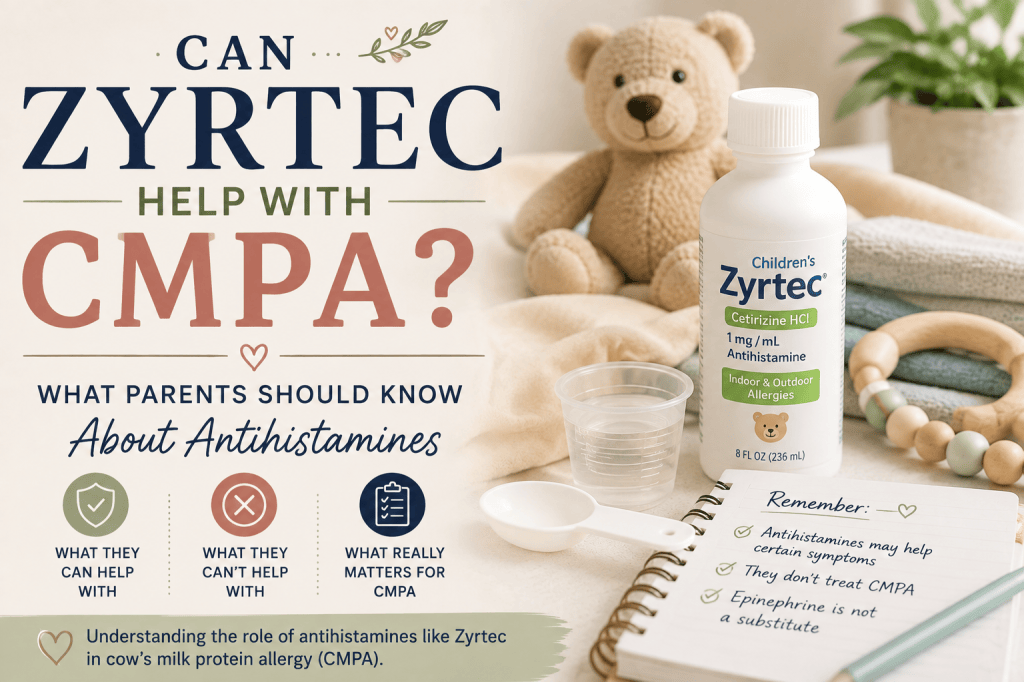
When you first hear the words cow’s milk protein allergy, one question seems almost obvious: If it’s an allergy, wouldn’t an allergy medicine help? Parents may already have medications such as Zyrtec in the medicine cabinet for seasonal allergies, hives, or other allergic symptoms. So when a baby or child with CMPA develops a rash, itching, digestive symptoms, congestion, or another suspected reaction, it’s reasonable to wonder whether an antihistamine could make the CMPA symptoms go away. The answer is that sometimes an antihistamine can help certain symptoms of an allergic reaction, but it doesn’t treat CMPA itself. Understanding that distinction is particularly important because not every type of CMPA involves the same immune response.
What Does Zyrtec Actually Do?
Zyrtec is a brand name for cetirizine, a second-generation H1 antihistamine. Histamine is one of the chemicals the body can release during certain allergic reactions. By blocking H1 histamine receptors, cetirizine can reduce histamine-related symptoms, which is why antihistamines are commonly associated with symptoms such as itching and hives. But blocking histamine doesn’t remove the allergen or teach the immune system to tolerate cow’s milk protein. Think about it this way: antihistamines can sometimes turn down certain symptoms of an allergic response, but they don’t remove the underlying allergy. For a child with confirmed CMPA, management still revolves around avoiding the cow’s milk protein causing the reaction and following the child’s healthcare team’s plan.
Why the Type of CMPA Matters
This is where the subject becomes much more interesting. Cow’s milk allergy can involve different immune mechanisms, and that can help explain why an antihistamine might seem helpful for one child but do very little for another.
IgE-Mediated Cow’s Milk Allergy
IgE-mediated reactions typically occur relatively quickly after exposure and can include symptoms such as hives, itching, swelling, vomiting, respiratory symptoms, or potentially anaphylaxis. Histamine can play an important role in some of these symptoms. That’s where an antihistamine may sometimes have a role in relieving certain mild skin symptoms, depending on the child’s individual allergy action plan. But even here, antihistamines aren’t treating the milk allergy itself.
Non-IgE-Mediated Cow’s Milk Allergy
Many breastfed babies suspected of CMPA have symptoms that don’t fit the classic immediate IgE-allergy pattern. Symptoms may appear more slowly and can involve the gastrointestinal tract. In these situations, histamine isn’t necessarily the main mechanism driving the symptoms, which means giving an antihistamine doesn’t simply “switch off” the reaction. This helps explain something that otherwise seems confusing: CMPA is an allergy, but an antihistamine isn’t automatically a CMPA treatment.
👉 Not sure what kind of reaction actually points toward CMPA? Read [How Is Cow’s Milk Protein Allergy Diagnosed in Breastfed Babies? What Parents Can Expect].
What CMPA Symptoms Might an Antihistamine Help?
This is where we need to be precise. Antihistamines can be useful for relieving certain histamine-related symptoms, particularly itching and hives, when a healthcare professional has determined that an antihistamine is appropriate for the child. But that doesn’t mean the same medication will fix every symptom associated with CMPA. For example, an antihistamine shouldn’t be expected to resolve the underlying cause of persistent gastrointestinal symptoms associated with cow’s milk protein exposure. Improvement after an antihistamine also doesn’t prove that CMPA caused the original symptom.
Zyrtec Isn’t a Way to Make Dairy Safe
This is probably the biggest misconception to avoid. If your child has diagnosed cow’s milk allergy, giving an antihistamine before dairy exposure doesn’t make the dairy safe. Antihistamines don’t prevent all of the dangerous parts of a serious allergic reaction, and improving some visible symptoms doesn’t necessarily mean a reaction has completely stopped. Parents should follow their child’s allergist or pediatrician’s allergy action plan rather than trying to use an antihistamine as a protective shield before exposure.
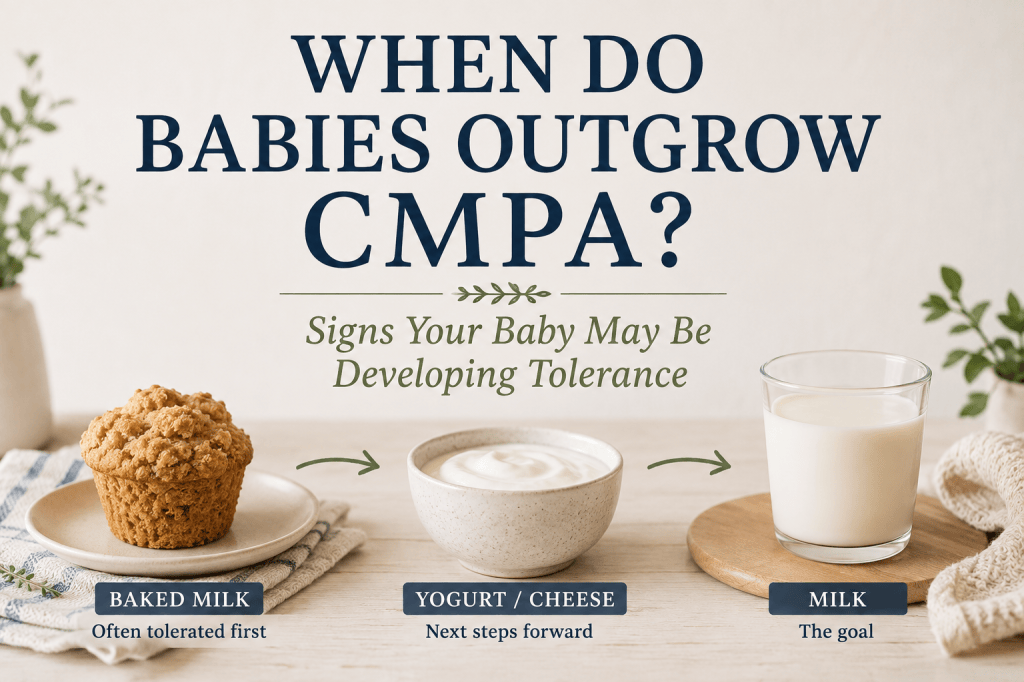
👉 Wondering when dairy might eventually be appropriate again? Read [When Do Babies Outgrow CMPA? Signs Your Baby May Be Developing Tolerance].
Antihistamines Are NOT a Substitute for Epinephrine
This point is especially important. If a child is experiencing anaphylaxis, antihistamines such as cetirizine aren’t substitutes for epinephrine. Antihistamines may help certain skin symptoms, but they don’t adequately treat the dangerous breathing or cardiovascular problems that can occur during anaphylaxis. Epinephrine remains the first-line treatment for anaphylaxis, and an antihistamine should never delay its use when a child’s emergency allergy plan indicates epinephrine is needed. Parents of children with known IgE-mediated food allergies should follow the emergency plan provided by their healthcare team.
What About Eczema?
This is another important connection. If your CMPA baby also has eczema, an antihistamine might sound particularly appealing because eczema can be itchy. But eczema isn’t simply a histamine reaction. Antihistamines don’t repair the damaged skin barrier or treat the underlying inflammatory process involved in atopic dermatitis. That means a child’s eczema management and food-allergy management may involve very different strategies.
👉 For a deeper look at why eczema and food allergy frequently occur together, read [Can Eczema Lead to Food Allergies in Babies? The Skin Barrier Connection].
If a baby’s skin suddenly becomes worse, it’s also worth thinking about what touched the skin, not just what the baby ate.
👉 Read [Aquaphor, Lanolin & CMPA: Could It Be Causing Your Baby’s Rash?] for one example of a topical exposure parents may overlook.
Can You Use Zyrtec to Figure Out Whether a Baby Has CMPA?
No. It can be tempting to think, “I’ll give Zyrtec. If the symptoms improve, that proves it’s an allergy.” Unfortunately, allergy diagnosis doesn’t work that way. A symptom improving after an antihistamine doesn’t identify what originally caused it, and symptoms not improving with an antihistamine don’t rule out CMPA either. Diagnosis depends on the child’s symptoms, timing, medical history, the suspected type of reaction, elimination and reintroduction when appropriate, and sometimes allergy testing or supervised food challenges.
👉 Read [The Cow’s Milk Protein Allergy Elimination Diet While Breastfeeding: A Complete Step-by-Step Guide] for more about how dairy elimination fits into the process.
What About Giving Zyrtec to Babies?
This is one area where an online article shouldn’t become a dosing chart. Different cetirizine products can have different labeling, formulations, concentrations, and age directions. Don’t start giving a baby or young child cetirizine specifically for suspected CMPA without discussing it with their pediatrician or allergist. A healthcare professional can determine whether an antihistamine makes sense, which medication and formulation are appropriate, and how it fits into the child’s overall allergy plan.
The Simple Way to Think About It
The easiest distinction to remember is this: CMPA management addresses exposure to the cow’s milk protein causing the problem, while an antihistamine may relieve certain histamine-related symptoms. Those aren’t interchangeable. A child can have a food allergy and still have symptoms that an antihistamine won’t meaningfully improve, and a child can have itching or hives that improve after an antihistamine without that proving cow’s milk protein caused them.
So, Can Zyrtec Help With CMPA?
It can sometimes help certain mild histamine-related symptoms associated with an allergic reaction, particularly itching and hives, when its use is appropriate for that child. But Zyrtec doesn’t cure CMPA, doesn’t make dairy exposure safe, doesn’t reliably treat the gastrointestinal symptoms associated with non-IgE CMPA, isn’t a diagnostic test for CMPA, and isn’t a substitute for epinephrine in anaphylaxis. That’s the distinction parents really need to know.
Zyrtec vs. Benadryl for Allergic Reactions
Once parents understand that antihistamines don’t actually treat CMPA itself, the next question is often which antihistamine should be used if one is appropriate. Benadryl is a brand name for diphenhydramine, an older first-generation antihistamine, while cetirizine is a newer second-generation antihistamine. One of the major differences is sedation. Diphenhydramine can cause significant drowsiness and other side effects, while newer-generation antihistamines such as cetirizine generally cause less sedation. That doesn’t mean parents should simply replace Benadryl with Zyrtec on their own. For a child with a diagnosed food allergy, the better approach is an individualized allergy action plan explaining exactly what medication should be used for different symptoms.
Can an Antihistamine Hide a Serious Reaction?
Imagine a child eats something containing milk and develops hives. The parent gives an antihistamine and the hives begin disappearing. It’s tempting to think, “Great, the reaction is over.” But improvement in skin symptoms doesn’t necessarily tell you what’s happening elsewhere in the body. Antihistamines primarily help certain histamine-related symptoms such as itching and hives. They don’t adequately treat the dangerous respiratory or cardiovascular symptoms of anaphylaxis. That’s why antihistamines should never be used to delay epinephrine when a child’s symptoms meet the criteria in their emergency allergy plan. The fact that a rash looks better doesn’t automatically mean a serious allergic reaction cannot progress.
Why This Can Be Different With Non-IgE CMPA
This distinction is especially relevant because many parents dealing with CMPA are seeing symptoms such as mucus or blood in stool, digestive discomfort, reflux-like symptoms, feeding difficulties, or symptoms that develop hours or even days after milk exposure. Those patterns can be very different from an immediate IgE-mediated reaction involving hives shortly after eating dairy. If your baby’s symptoms are caused by a non-IgE-mediated reaction, taking an H1 antihistamine isn’t addressing the primary immune mechanism responsible for the condition. That’s why a parent might give an antihistamine and notice absolutely no meaningful difference in the symptoms. That doesn’t automatically mean, “It can’t be CMPA.” It may simply mean those symptoms weren’t being driven primarily by histamine.
👉 If you’re trying to understand why CMPA symptoms can take time to improve, read [When Will My Baby Feel Better After Going Dairy-Free? What to Expect Week by Week].
What If Zyrtec Seems to Help My Baby’s Rash?
Tell your pediatrician, but don’t use the response to medication as a home diagnostic test. If a rash improves after cetirizine, that tells you the medication may have reduced a histamine-related component of the symptoms. It doesn’t tell you what caused the rash. Milk, another food, an environmental allergen, hives following an infection, a contact reaction, or something else entirely could be involved. The response to an antihistamine alone can’t answer that question, and babies can sometimes have more than one thing going on at the same time.
👉 If your baby’s skin suddenly changed after introducing a new ointment or moisturizer, read [Aquaphor, Lanolin & CMPA: Could It Be Causing Your Baby’s Rash?].
Does Zyrtec Help CMPA Eczema?
Not in the way parents sometimes imagine. Eczema isn’t simply an allergic rash caused by histamine. Atopic dermatitis involves inflammation and problems with the skin barrier. Although eczema and food allergy frequently overlap, giving an antihistamine doesn’t repair that barrier or eliminate the underlying eczema. If itching is significant, a healthcare professional may sometimes consider medications as part of a broader treatment plan, but eczema management shouldn’t be reduced to giving an antihistamine.
👉 Read [Can Eczema Lead to Food Allergies in Babies? The Skin Barrier Connection] to understand why eczema and food allergy are connected in ways that go far beyond a simple rash.
Could Giving Zyrtec Before Dairy Prevent a Reaction?
No. If your child has diagnosed cow’s milk allergy, don’t intentionally give an antihistamine and then expose them to dairy to see what happens. Antihistamines don’t make an allergenic food safe, and they aren’t a substitute for medically guided reintroduction, an oral food challenge, or a milk ladder when one is appropriate.
👉 If you’re wondering when dairy might safely be tried again, read [When Can I Try Dairy Again While Breastfeeding? What Moms Need to Know About Reintroduction].
👉 For children progressing toward direct dairy reintroduction, read [What Is the Milk Ladder? A Simple Guide for Parents of Babies With CMPA].
An Interesting Label Question: Does Zyrtec Contain Dairy?
This gets surprisingly confusing because some cetirizine products may list lactose monohydrate among their inactive ingredients. Seeing the word lactose understandably makes a parent managing CMPA stop immediately, but lactose and cow’s milk protein aren’t the same thing. Lactose is a sugar. CMPA is an immune reaction to cow’s milk proteins. So a product containing lactose isn’t automatically equivalent to a product containing the milk proteins responsible for CMPA. Medication formulations can vary by manufacturer and product, however, so families dealing with a confirmed milk allergy should ask their pharmacist or allergist about the exact medication being considered rather than assuming every cetirizine product has identical inactive ingredients. This is also why checking the specific product label matters more than simply searching whether “Zyrtec contains dairy.”
Should I Keep Zyrtec at Home Because My Baby Has CMPA?
Having CMPA alone doesn’t tell us what emergency medications a particular child needs. A baby with delayed gastrointestinal symptoms and a child with a history of immediate IgE-mediated milk reactions may have completely different management plans. Rather than assembling your own allergy emergency kit from information online, ask your pediatrician or allergist what type of milk allergy your child appears to have, which symptoms you should watch for, whether an antihistamine should be available, which medication and formulation are appropriate, whether epinephrine is needed, and exactly when each medication should be used. Having those answers written down is much more useful than trying to make the decision for the first time while your child is having symptoms.
Frequently Asked Questions
Can Zyrtec stop a CMPA reaction?
Zyrtec may help certain mild histamine-related symptoms, particularly itching and hives, when its use is appropriate for that child. It does not stop the underlying cow’s milk allergy, and it doesn’t reliably treat every symptom associated with CMPA.
Will Zyrtec help mucus or blood in my baby’s poop from CMPA?
An antihistamine isn’t considered a treatment for the underlying delayed gastrointestinal inflammation associated with non-IgE cow’s milk allergy. If your baby has blood in their stool or persistent gastrointestinal symptoms, contact their pediatrician rather than attempting to treat the problem with an antihistamine.
Will Zyrtec help CMPA reflux?
Cetirizine isn’t a treatment for reflux or the underlying gastrointestinal manifestations of CMPA. If reflux-like symptoms appear to be associated with cow’s milk protein, appropriate management depends on the baby’s diagnosis and feeding situation.
Can I give my baby Zyrtec?
Don’t use this article to determine whether cetirizine is appropriate for your baby or how much to give. Age recommendations and directions vary by formulation and product. Your pediatrician or pharmacist can tell you whether it’s appropriate and provide the correct product-specific instructions.
Is Benadryl better than Zyrtec for food allergies?
Not necessarily. Modern allergy guidance has increasingly moved away from routinely relying on sedating first-generation antihistamines such as diphenhydramine when newer-generation options are appropriate. But neither medication replaces epinephrine for anaphylaxis. Your child’s allergist or pediatrician should determine what belongs in their individual treatment plan.
If Zyrtec makes the symptoms disappear, does that prove it was an allergy?
No. A response to an antihistamine isn’t a diagnostic test for CMPA.
Can I give an antihistamine before trying the milk ladder?
Don’t premedicate a child with an antihistamine simply to make dairy reintroduction easier unless your child’s healthcare professional has specifically instructed you to do so. You don’t want to intentionally suppress symptoms that may be important when determining whether a milk-ladder step has been tolerated.
The Bottom Line
Calling CMPA an allergy can make antihistamines seem like an obvious treatment, but food allergy is more complicated than allergy = histamine = antihistamine fixes it. For some immediate IgE-mediated reactions, histamine contributes to symptoms such as itching and hives, and an antihistamine may sometimes have a role. For many delayed, non-IgE gastrointestinal manifestations of CMPA, an antihistamine may provide little or no benefit. And in a serious allergic reaction, antihistamines are not substitutes for epinephrine.
So rather than asking only, “Can I give Zyrtec for CMPA?”, a better question for your child’s healthcare provider is: “What type of reaction does my child have, and what should I do when it happens?” That answer tells you far more than the name of any medication ever could.
Related Articles
How Is Cow’s Milk Protein Allergy Diagnosed in Breastfed Babies? What Parents Can Expect
When Will My Baby Feel Better After Going Dairy-Free? What to Expect Week by Week
Can Eczema Lead to Food Allergies in Babies? The Skin Barrier Connection
Aquaphor, Lanolin & CMPA: Could It Be Causing Your Baby’s Rash?
When Can I Try Dairy Again While Breastfeeding? What Moms Need to Know About Reintroduction
What Is the Milk Ladder? A Simple Guide for Parents of Babies With CMPA
Medical Disclaimer
This article is for educational and informational purposes only and isn’t a substitute for medical advice, diagnosis, treatment, or an individualized allergy action plan. Do not give a baby or child medication, intentionally expose a child to a known or suspected allergen, or change an existing allergy treatment plan based on this article. Ask your child’s pediatrician, allergist, or pharmacist about appropriate medications and dosing. For a serious allergic reaction or suspected anaphylaxis, follow your child’s emergency allergy plan and seek emergency medical care.





Leave a comment