When your baby has CMPA, you become a detective.
A rash appears and you start mentally reviewing everything.
Did I accidentally eat dairy? Did the baby eat something new? Was there hidden milk somewhere? Is this another CMPA flare?
But there’s another category that’s easy to overlook:
What did you put on your baby’s skin?
Products used for dry skin, eczema, diaper irritation, chapped cheeks, and other common baby skin problems can contain ingredients capable of causing contact reactions in some children.
One ingredient worth knowing about is lanolin.
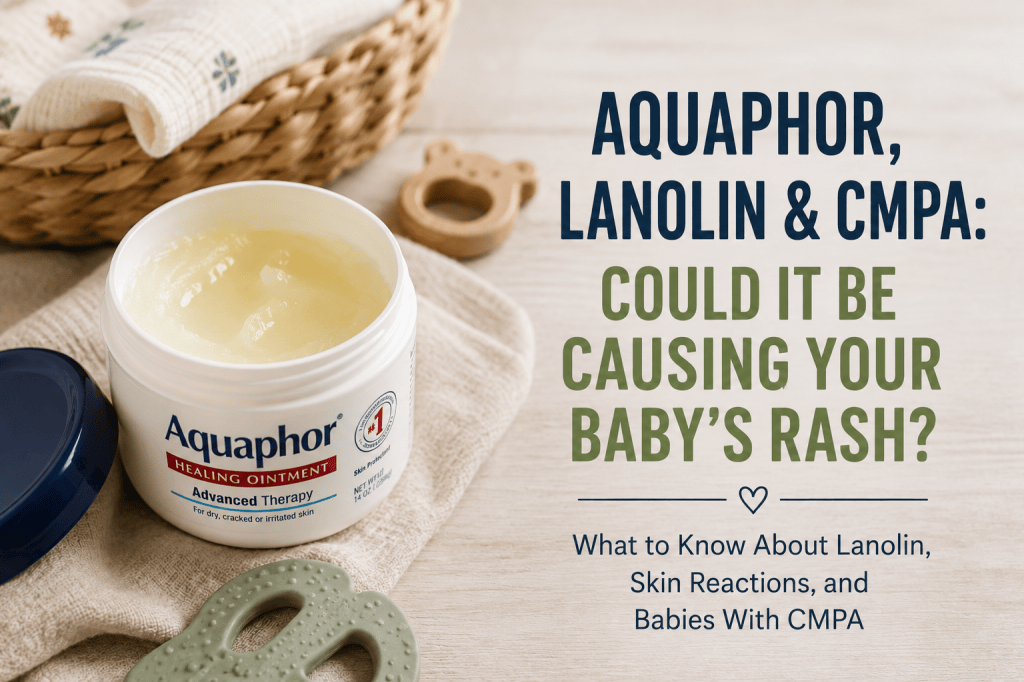
And there’s an important reason I’m bringing it up: Aquaphor Healing Ointment contains lanolin alcohol.
That absolutely does not mean Aquaphor is unsafe for babies with CMPA. It doesn’t mean babies with CMPA are automatically allergic to lanolin. And it certainly doesn’t mean every rash that appears after using Aquaphor was caused by it.
But if your child’s skin suddenly becomes worse and you’re trying to figure out what changed, a new topical product belongs on your checklist right alongside food exposures.
First: Lanolin Allergy and CMPA Are Not the Same Thing
This is the most important distinction in this entire article.
Cow’s milk protein allergy is an immune reaction involving proteins found in cow’s milk.
Lanolin is a substance derived from sheep’s wool and is used in many skin-care and cosmetic products. Lanolin and its derivatives may appear on labels under several names, including lanolin alcohol, wool alcohols, wool fat, wool wax, and wool grease.
So this isn’t a situation where Aquaphor secretly contains cow’s milk protein.
It doesn’t.
And a reaction to lanolin doesn’t mean your child’s CMPA is somehow reacting to sheep’s wool.
These are separate issues.
👉 There’s another reason researchers are paying close attention to the skin barrier in babies with eczema. Read [Can Eczema Lead to Food Allergies in Babies? The Skin Barrier Connection] for a look at how impaired skin may potentially contribute to food sensitization.
So Why Are CMPA Parents Talking About Lanolin?
This is where I think some internet discussions blur two different things together.
There’s evidence that children with atopic dermatitis can be more likely to show contact reactions to lanolin. Pediatric contact-dermatitis research has found higher reaction frequencies to lanolin or wool alcohols among children with atopic dermatitis, and dermatology guidance identifies already damaged or inflamed skin as a risk factor for lanolin sensitization.
CMPA and eczema can also occur in the same child.
That creates a possible overlap:
CMPA → child also has eczema/irritated skin → parents use lots of emollients and skin products → one of those products contains lanolin → susceptible skin reacts.
That’s very different from saying:
CMPA → lanolin allergy.
I couldn’t find strong evidence supporting that direct relationship, so I wouldn’t tell parents that it exists.
Aquaphor Really Does Contain Lanolin Alcohol
This surprises some parents because Aquaphor is so commonly used for sensitive and irritated skin.
The current Aquaphor Healing Ointment formula lists 41% petrolatum as its active skin-protectant ingredient, along with mineral oil, ceresin, lanolin alcohol, panthenol, glycerin, and bisabolol.
Again, that doesn’t make Aquaphor a bad product.
Most people won’t develop an allergic reaction to lanolin. Estimates of lanolin allergy vary depending on the population studied, and rates are substantially higher among people already being patch-tested for dermatitis than in the general population.
But lanolin alcohol is there, which makes it worth remembering when you’re troubleshooting an unexplained skin reaction.
What Can a Lanolin Contact Reaction Look Like?
Lanolin can be associated with allergic contact dermatitis as well as irritant reactions. Allergic contact dermatitis is generally a delayed reaction, often developing hours to days after exposure rather than necessarily appearing the instant the product touches the skin.
Parents might notice the skin becoming more red, itchy, irritated, swollen, or otherwise worse where the product was applied. Pre-existing dermatitis can also deteriorate after exposure to a topical ingredient the skin doesn’t tolerate.
That pattern is particularly useful when you’re playing detective.
If your baby’s cheeks suddenly look much worse, ask yourself:
What did they eat?
But also:
What did I put on their cheeks?
The Location of the Rash Can Be a Clue
Suppose you put a new ointment only around your baby’s mouth and cheeks and that’s exactly where the irritation worsens.
That doesn’t prove the ointment caused it.
But it’s useful information.
Likewise, if you begin using something new in the diaper area and that’s where the skin changes, write that down.
Contact dermatitis tends to occur where the skin has been exposed to the offending substance, although reactions aren’t always perfectly confined to one area.
Don’t Automatically Blame Dairy
This is really the reason I wanted this article on the site.
Once you’ve lived with CMPA for a while, dairy becomes the prime suspect for everything.
New rash? Dairy.
Bad diaper? Dairy.
Fussy afternoon? Hidden dairy.
Sometimes dairy really is responsible.
But sometimes something else changed.
A new lotion. New sunscreen. New diaper cream. New soap. New detergent. New wipes. New ointment.
Or Aquaphor.
When symptoms suddenly change, don’t only make a mental list of what went into your baby.
Make another list of what went onto your baby.
What Should You Do If You Think a Product Is Irritating Your Baby’s Skin?
Stop using a suspected new skin product and contact your child’s pediatrician or dermatologist if the reaction is significant, worsening, persistent, or you’re uncertain what you’re seeing. Aquaphor’s own current drug labeling advises stopping use and asking a doctor if the condition worsens or persists.
Don’t diagnose a lanolin allergy from one rash.
A dermatologist can evaluate persistent or recurrent contact dermatitis, and patch testing is one method used to investigate suspected allergic contact dermatitis to lanolin.
And don’t start removing additional foods from your baby’s or your own diet solely because a skin reaction appeared after introducing a topical product.
That could send you in completely the wrong direction.
One Simple Thing to Remember
If your CMPA baby’s skin suddenly changes, ask yourself two questions:
What did they eat?
What touched their skin?
That second question is incredibly easy to forget.
Aquaphor and other lanolin-containing products work well for many families. A child having CMPA does not mean they’re going to react to lanolin.
But lanolin contact reactions are real, children with eczema or compromised skin may be more susceptible, and Aquaphor Healing Ointment does contain lanolin alcohol.
So when you’re trying to identify the one thing you did differently yesterday?
Check the medicine cabinet along with the refrigerator.
Part 2: What Else Should Parents Know About Lanolin, Aquaphor, and CMPA?
One of the hardest things about caring for a baby with CMPA is figuring out whether a new symptom is actually related to cow’s milk protein allergy.
Once you’ve spent weeks checking food labels and watching symptoms, it’s natural for dairy to be the first thing that comes to mind. But skin reactions can have many possible causes, and sometimes the clue is hiding on the ingredient list of a product rather than a food label.
Lanolin Can Appear Under Different Names
If you and your child’s healthcare provider suspect lanolin could be contributing to a skin reaction, simply looking for the word “lanolin” may not always be enough.
Depending on the product, related ingredients may be listed as:
- Lanolin
- Lanolin alcohol
- Wool alcohols
- Wool fat
- Wool wax
- Wool grease
Lanolin derivatives can be found in moisturizers, ointments, cosmetics, lip products, and other topical preparations.
This doesn’t mean parents of babies with CMPA need to start avoiding every product containing these ingredients.
Most importantly, CMPA itself is not a reason to automatically avoid lanolin.
Instead, think of this information as another troubleshooting tool if your child’s skin unexpectedly gets worse after you’ve introduced something new.
What About Breastfeeding Nipple Creams?
This is another place breastfeeding moms may encounter lanolin.
Lanolin is commonly used in nipple creams intended to help with dry or cracked skin during breastfeeding.
Again, there is no reason for every breastfeeding mom whose baby has CMPA to automatically stop using lanolin nipple cream based on CMPA alone.
But if you notice unexplained irritation involving either your own skin or your baby’s skin, it’s worth mentioning all topical products being used when you talk with your healthcare provider, including nipple creams.
👉 Trying to figure out whether your baby’s symptoms really point to cow’s milk protein allergy? Read [How Is Cow’s Milk Protein Allergy Diagnosed in Breastfed Babies? What Parents Can Expect].
A Simple “What Changed?” Checklist
When your baby’s skin suddenly looks different, try thinking back over the previous few days rather than immediately assuming there was a dairy exposure.
Ask yourself:
Did we introduce a new food?
Did I eat something that might have contained dairy?
Did we change formula?
Did we start a new lotion, ointment, diaper cream, sunscreen, soap, shampoo, wipe, or detergent?
Did I start using a different breastfeeding or nipple-care product?
Was the new product applied to the same area where the irritation appeared?
Has my baby’s eczema or normally sensitive skin already been irritated recently?
That little investigation may give your pediatrician much more useful information than simply saying, “Their CMPA symptoms came back.”
👉 If you’re worried there really was an accidental dairy exposure, read [Why Symptoms Return After Accidental Dairy Exposure: What to Expect].
Should You Switch to a Lanolin-Free Product?
Not automatically.
If Aquaphor or another lanolin-containing product has worked well for your baby without causing problems, there’s no evidence-based reason to stop using it simply because your baby has CMPA.
If you notice a new reaction after starting a product, however, stop using the suspected product and discuss the reaction with your child’s healthcare provider, especially if the irritation is significant or doesn’t improve.
If lanolin contact allergy is genuinely suspected, a dermatologist may use patch testing as part of the evaluation.
Rather than continually experimenting with different products on already-irritated skin, your pediatrician or dermatologist can also help you choose an appropriate alternative for your child’s particular skin problem.
Frequently Asked Questions
Does Aquaphor contain dairy?
Aquaphor Healing Ointment does not list cow’s milk protein as an ingredient. It does, however, contain lanolin alcohol.
Lanolin comes from sheep’s wool, so a reaction to lanolin and an allergy to cow’s milk protein are different issues.
Does CMPA mean my baby is allergic to lanolin?
No.
There isn’t good evidence showing that having CMPA automatically makes a baby allergic to lanolin.
The more relevant connection appears to involve eczema, atopic dermatitis, and damaged skin, which can coexist with food allergies. Children with atopic dermatitis have shown higher rates of contact reactions to certain allergens, including lanolin/wool alcohols, in pediatric contact-dermatitis research.
Can Aquaphor make eczema worse?
Aquaphor is commonly used as a skin protectant, and many people tolerate it well. However, an individual can develop allergic or irritant contact dermatitis to ingredients in topical products, including lanolin.
If your child’s skin consistently becomes worse where a particular product is being applied, stop using it and talk with your pediatrician or dermatologist.
How would I know if my baby has a lanolin allergy?
You can’t reliably diagnose a lanolin allergy just by looking at a rash.
A healthcare professional can evaluate the pattern and other possible causes. Dermatologists can use patch testing when allergic contact dermatitis is suspected.
Should every baby with CMPA use lanolin-free skin products?
No.
CMPA alone isn’t a reason to eliminate lanolin-containing skin products.
This article is simply a reminder that topical products belong on the list of things to consider when an unexplained skin reaction appears.
Final Thoughts
If there’s one thing to take away from this article, it’s not that Aquaphor is bad or that babies with CMPA can’t use lanolin.
It’s this:
When something suddenly changes, think beyond food.
Parents managing CMPA become exceptionally good at reading food labels. Sometimes we need to remember to turn over the lotion bottle and read that label too.
If you recently introduced Aquaphor, a new lotion, diaper cream, nipple cream, sunscreen, or another topical product and your baby’s skin suddenly looks different, make a note of it.
It might be unrelated.
It might be irritation.
It might be eczema.
It could potentially be contact dermatitis.
Or dairy really could be involved.
The goal isn’t to diagnose the cause yourself. It’s to notice the pattern and give your child’s healthcare provider the best possible information to help figure it out.
👉 If you’re still trying to determine whether dairy is behind your baby’s symptoms, read [Baby Still Has CMPA Symptoms After Cutting Dairy? Here’s What to Check].
Related Articles
How Is Cow’s Milk Protein Allergy Diagnosed in Breastfed Babies? What Parents Can Expect
Baby Still Has CMPA Symptoms After Cutting Dairy? Here’s What to Check
Why Symptoms Return After Accidental Dairy Exposure: What to Expect
50 Hidden Sources of Dairy (Even Dairy-Free Moms Miss These)
The Cow’s Milk Protein Allergy Elimination Diet While Breastfeeding: A Complete Step-by-Step Guide
Medical Disclaimer
This article is for educational and informational purposes only and is not a substitute for medical advice, diagnosis, or treatment. Skin reactions in babies can have many causes. If your baby develops a new, persistent, worsening, or concerning rash or other symptoms, contact your pediatrician or another qualified healthcare professional. Seek urgent medical care for signs of a serious allergic reaction, such as difficulty breathing or significant swelling.






Leave a comment