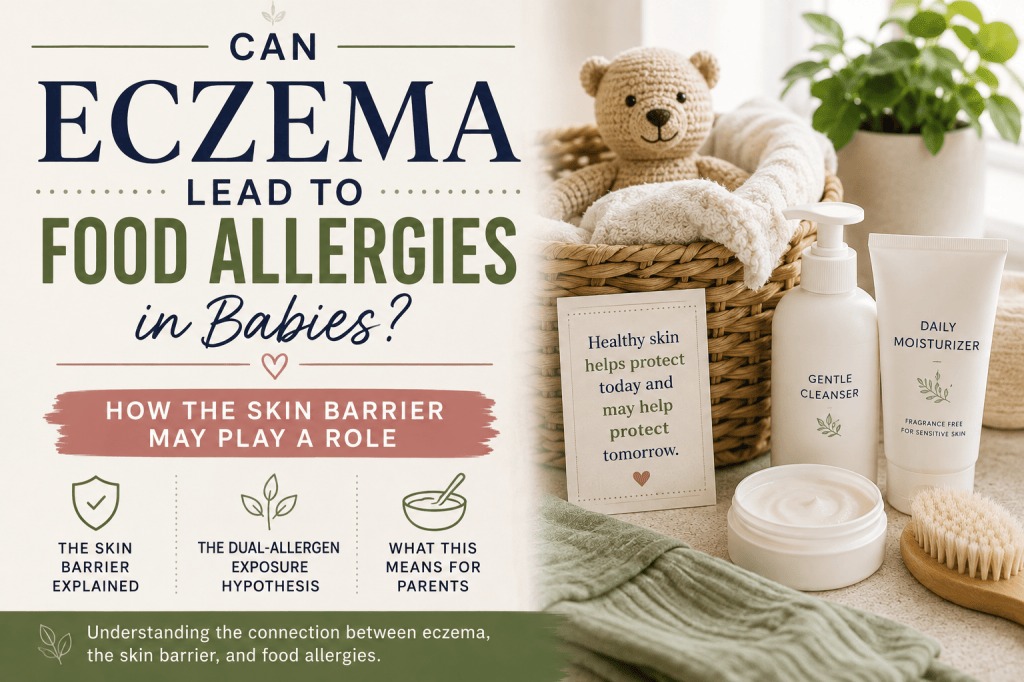
Can Eczema Lead to Food Allergies in Babies? The Skin Barrier Connection
For a long time, the relationship between eczema and food allergies seemed pretty straightforward. A baby had eczema. The baby was later diagnosed with a food allergy. So naturally, parents wondered whether the food allergy had been causing the eczema all along. Sometimes food can play a role in symptoms. But researchers have discovered that the relationship may also work in a direction many parents would never expect. In some babies, problems with the skin barrier may come first. And that damaged or inflamed skin may potentially make it easier for the immune system to become sensitized to food proteins in the environment. It’s one of the most fascinating areas of modern food-allergy research, and there’s even a name for the theory behind it: The dual-allergen exposure hypothesis.
👉 If your baby is still having symptoms after you’ve removed dairy, read [Baby Still Has CMPA Symptoms After Cutting Dairy? Here’s What to Check].
Your Baby’s Skin Is More Than Something You Can See
We usually think about skin in terms of how it looks. Dry. Smooth. Red. Irritated. But skin is also an incredibly important protective barrier between the body and the outside world. Healthy skin helps keep moisture in while keeping environmental substances out. With atopic dermatitis, commonly called eczema, that barrier doesn’t always function normally. Genetics, inflammation and differences in important components of the skin can all contribute to skin-barrier dysfunction. That means researchers aren’t only interested in what eczema looks like. They’re interested in what can potentially get through that compromised barrier. And that’s where food allergy enters the picture.
How Would Food Get Onto a Baby’s Skin Before They Eat It?
At first, this sounds strange. How could a baby encounter peanut, egg, milk or another food through their skin if they haven’t started eating those foods yet? Think about everything happening around a baby. Adults eat food and then touch toys, furniture, clothing and their baby. Food is prepared in the kitchen. Older siblings eat snacks. Tiny amounts of food proteins can become part of the baby’s environment. Researchers have found evidence supporting the possibility that environmental food allergens can penetrate an impaired skin barrier and contribute to sensitization. Studies involving peanut exposure in household dust and infants with atopic dermatitis have been particularly important in developing this theory. That doesn’t mean parents need to disinfect their homes after eating peanut butter. It means researchers realized something important: The route by which the immune system first encounters a food may matter.
Skin Exposure and Oral Exposure May Send Different Messages
This is the heart of the dual-allergen exposure hypothesis Imagine an infant with eczema whose skin barrier is inflamed and impaired. Tiny amounts of a food protein reach that compromised skin. Instead of simply ignoring the protein, the immune system may become sensitized to it. Sensitization means the immune system has developed an immune response to an allergen. Importantly, sensitization isn’t automatically the same thing as having a clinically confirmed food allergy. Now consider another pathway. The infant becomes developmentally ready for solids and encounters an allergenic food by eating it. Exposure through the gastrointestinal tract can promote something very different: oral tolerance. Essentially, the immune system learns that the food is something it should tolerate rather than attack. Researchers describe this contrast between exposure through impaired skin and exposure through the digestive system as the dual-allergen exposure hypothesis. In very simplified terms: Compromised skin + environmental food exposure → may promote sensitization while Appropriate oral exposure → may promote tolerance That’s an oversimplification of an incredibly complicated immune process, but it’s a useful way for parents to understand the basic concept.
👉 Eczema can affect much more than how a baby’s skin looks, especially when itching begins interfering with comfort and rest. Read [Can CMPA Affect Baby Sleep? Why Your Baby May Be Waking So Often] for more about how eczema and other CMPA-associated symptoms may disrupt sleep.
This Changed How We Think About Preventing Food Allergy
One of the clearest examples involves peanut allergy. For years, parents of babies considered at high risk for allergies were often cautious about introducing allergenic foods. Then major research began showing that earlier oral introduction of peanut in certain high-risk infants could actually reduce the likelihood of developing peanut allergy. Current NIAID guidance recommends considering peanut introduction as early as 4 to 6 months for infants with severe eczema, egg allergy, or both, after appropriate evaluation by a healthcare provider. For babies with mild-to-moderate eczema, introduction around 6 months is suggested. That’s almost the opposite of what many parents would intuitively expect. A baby at higher allergy risk doesn’t necessarily benefit from simply avoiding an allergenic food for longer. In certain situations, appropriately timed oral exposure may actually help establish tolerance.
So Does Eczema Cause CMPA?
This is where we need to be careful. We can’t say that eczema causes cow’s milk protein allergy. Babies with atopic dermatitis have a substantially increased risk of food sensitization and food allergy compared with children without it, and earlier or more severe eczema appears particularly associated with food allergy. But association isn’t destiny. Plenty of babies have eczema and never develop food allergies. And plenty of babies develop food allergies through complicated pathways that can’t be reduced to one explanation. The skin-barrier theory gives researchers an important piece of the puzzle. It doesn’t give parents one universal explanation for why their child developed CMPA.
👉 Wondering how doctors actually determine whether symptoms are CMPA? Read [How Is Cow’s Milk Protein Allergy Diagnosed in Breastfed Babies? What Parents Can Expect].
And Food Doesn’t Always Cause the Eczema Either
This is another misconception worth clearing up. If a baby has eczema and CMPA, it’s tempting to assume:
“The milk allergy must be causing all of the eczema.” That’s not necessarily true. Atopic dermatitis is a complex inflammatory skin condition. Although food allergy and eczema frequently occur together, food isn’t automatically the underlying cause of eczema, and unnecessarily eliminating foods based only on eczema can lead parents down the wrong path. That distinction matters enormously for families already dealing with CMPA. We don’t want every eczema flare to lead to another food being removed from Mom’s diet or the baby’s diet. Sometimes the skin itself needs attention.
Why Treating Eczema Matters
This research gives parents another reason to take eczema seriously. Managing eczema isn’t simply about making a rash disappear. Researchers are actively studying whether improving and protecting the skin barrier early in life could potentially reduce allergen sensitization through the skin. The evidence around specific prevention strategies is still developing, and studies of moisturizers and other skin-barrier interventions haven’t produced a simple universal solution. So I would not turn this into: “Moisturize your baby and you can prevent food allergies.” Science isn’t there. But appropriate treatment of a baby’s eczema remains important, and parents should work with their pediatrician or dermatologist rather than allowing significant eczema to remain untreated. And after what we just discussed in the previous article, there’s another important piece:
The products being used on irritated skin matter too.
👉 If a new ointment seems to make your baby’s skin worse, read [Aquaphor, Lanolin & CMPA: Could It Be Causing Your Baby’s Rash?].
The Big Idea
This changes the way I think about the eczema-food allergy relationship. Instead of only asking: “Is my baby’s food allergy causing their eczema?” there’s another scientifically interesting question: “Could problems with the skin barrier have contributed to the development of food sensitization in the first place?” For some children, researchers increasingly believe that pathway may be part of the story. And that makes eczema much more than simply another symptom parents of babies with allergies happen to encounter. It may be part of the biology connecting the skin, immune system and development of food allergy.
Part 2: What Does the Eczema and Food Allergy Connection Mean for Parents?
Learning about the skin-barrier connection can be fascinating, but it can also make parents wonder whether they should suddenly change everything they’re doing. Should you keep certain foods out of the house? Should you introduce allergens earlier? Could you have prevented your baby’s allergy by treating eczema differently? The answer to that last question is especially important: You cannot look backward and conclude that your baby’s eczema caused their food allergy or that you could have prevented it. Food allergies develop through a complicated combination of genetics, immune responses, environmental exposures, skin-barrier function, and other factors researchers are still working to understand. The dual-allergen exposure hypothesis gives us one possible pathway. It isn’t an explanation for every child’s allergy. What it can do is help us understand why pediatricians and allergists now pay so much attention to both eczema management and appropriate oral introduction of allergenic foods.
Don’t Introduce Foods by Putting Them on Your Baby’s Skin
This deserves its own section because the dual-allergen exposure theory can lead to exactly the wrong conclusion. If oral exposure can promote tolerance, parents may wonder whether allowing a baby to touch a food before eating it is a gentle way to introduce an allergen. That’s not how allergenic foods should intentionally be introduced. Putting peanut butter, milk, egg, or another food directly onto eczema or irritated skin isn’t a recommended way to test whether your baby is allergic. The entire theory we’ve been discussing suggests why exposure through damaged skin may be different from eating the food. Food introduction should happen orally and in an age-appropriate form, following your pediatrician’s guidance, especially when a baby already has severe eczema or a known food allergy.
What About Food Getting on Baby’s Face While Eating?
Now we get into real life. Babies are messy. Puree gets on their cheeks. Yogurt ends up in their hair. Peanut butter somehow reaches an eyebrow. Food gets absolutely everywhere. The goal isn’t to become terrified of food touching your baby’s skin. Instead, if your baby has significant eczema, particularly around the mouth or hands, ask your pediatrician or dermatologist how they want you to manage the skin during food introduction. The important distinction is between normal incidental contact while eating and intentionally using the skin as the route of allergen introduction.
Severe Eczema Changes the Conversation About Allergen Introduction
Parents sometimes hear the general advice that introducing allergenic foods earlier may help reduce food-allergy risk and assume every baby should follow exactly the same process. There are important exceptions. For example, current U.S. peanut-allergy prevention guidance specifically identifies babies with severe eczema and/or egg allergy as a higher-risk group. These infants may be candidates for peanut introduction around 4 to 6 months, but healthcare-provider evaluation may be appropriate before introduction. Babies with mild-to-moderate eczema are treated differently in that guidance. So the takeaway isn’t simply: “Introduce allergens as early as possible.” It’s: “Don’t unnecessarily delay allergenic foods, but make the introduction plan appropriate for your baby’s individual risk.” If your baby already has CMPA, severe eczema, another diagnosed food allergy, or a history of concerning reactions, talk with your pediatrician or allergist before deciding how to introduce additional allergens.
👉 Starting solids with CMPA? Read [CMPA and Starting Solids: What Parents Need to Know Before Baby’s First Foods].
Having CMPA Doesn’t Mean Your Baby Will Develop Other Food Allergies
This is another place where parents can become understandably nervous. Once you’ve watched your baby react to one food, introducing another major allergen can suddenly feel much scarier. But CMPA isn’t a prediction that your baby will eventually become allergic to eggs, peanuts, wheat, soy, or other foods. Some children do have multiple food allergies, particularly children with other allergic conditions, but many don’t. This is one reason unnecessary elimination can become problematic. Removing foods your baby has never reacted to simply because you’re worried they might develop another allergy isn’t the same thing as medically necessary avoidance.
👉 Wondering whether soy needs to disappear too? Read [Do I Have to Cut Out Soy Too While Dairy-Free Breastfeeding? What Most Moms Don’t Know].
Don’t Start Removing Foods Because of Eczema Alone
Imagine that your baby’s eczema gets worse. You remove dairy. It improves a little, then worsens again. So you remove soy. Then eggs. Then wheat. Soon you’re breastfeeding while eating an extremely restricted diet, yet you still don’t know whether any of those foods were responsible. That’s exactly what we want to avoid. Eczema naturally fluctuates, and many things besides food can affect it. Food allergy evaluation should be based on the baby’s history and appropriate medical evaluation rather than progressively removing foods every time the skin changes. This is especially important because unnecessary food avoidance can make it harder to provide a varied, nutritionally adequate diet.
👉 If dairy has already been removed but symptoms aren’t improving the way you expected, read [Baby Still Has CMPA Symptoms After Cutting Dairy? Here’s What to Check].
Protecting the Skin Barrier Still Matters
Even though researchers haven’t shown that simply moisturizing every baby will prevent food allergy, treating eczema appropriately is still important. Your baby’s pediatrician or dermatologist may recommend a skin-care routine designed to reduce inflammation, protect the skin barrier, and control flares. That might involve things such as appropriate bathing practices, moisturizers, prescription treatments when necessary, and identifying irritants or contact allergens. But there’s an important balance here. A baby with compromised skin may also be using more topical products than the average baby, which creates more opportunities for irritation or contact allergy. That’s why our previous article matters here too.
👉 If your baby’s eczema suddenly becomes worse after starting a new ointment or moisturizer, read [Aquaphor, Lanolin & CMPA: Could It Be Causing Your Baby’s Rash?].
Don’t assume the product is responsible, but don’t forget to put it on your “what changed?” list either.
Eczema, CMPA and the “Atopic March”
You may also come across the phrase atopic march when researching eczema and food allergy. It describes a pattern observed in some children where allergic conditions appear at different stages of childhood. Atopic dermatitis often occurs early, while food allergy, asthma, and allergic rhinitis may appear later. But “march” can make the process sound more predictable than it really is. A baby having eczema does not mean they’re destined to develop food allergies, asthma, and environmental allergies. Researchers increasingly recognize that there are different patterns and pathways rather than one inevitable sequence every child follows. For parents, the useful takeaway is much simpler: Eczema and food allergy frequently overlap, and the relationship between them is biologically meaningful. That doesn’t mean one diagnosis guarantees another.
What If My Baby Already Has CMPA and Eczema?
This is probably the question most relevant to readers of this blog. If your baby already has both, you don’t need to figure out which one “came first.” Instead, think about them as two issues that deserve appropriate management. For CMPA, that may mean following the elimination or feeding plan recommended by your baby’s healthcare provider and periodically reassessing whether continued avoidance is necessary. For eczema, it means treating the skin condition rather than assuming eliminating more and more foods will fix it. And when it becomes time to introduce other major allergens, your baby’s history of eczema and existing food allergy is information your pediatrician or allergist should know.
👉 For a step-by-step look at dairy elimination, read [The Cow’s Milk Protein Allergy Elimination Diet While Breastfeeding: A Complete Step-by-Step Guide].
Frequently Asked Questions
Can eczema actually cause a food allergy?
It’s more accurate to say that eczema and an impaired skin barrier may contribute to the development of food sensitization and food allergy in susceptible children. Research supports the idea that food proteins entering through compromised skin may encourage sensitization, but food allergy development is complex. We cannot say that eczema alone directly causes a child’s food allergy.
Does food entering broken skin make a baby allergic?
Not automatically. The dual-allergen exposure hypothesis proposes that allergen exposure through impaired skin may increase the likelihood of sensitization, particularly in susceptible infants. Exposure doesn’t guarantee allergy.
Is sensitization the same thing as food allergy?
No, and this is an important distinction. Sensitization means the immune system has developed measurable recognition of an allergen, such as allergen-specific IgE. A child can sometimes be sensitized without having clinical symptoms when the food is eaten. That’s one reason allergy testing needs to be interpreted alongside the child’s actual history rather than used by itself to diagnose every food allergy.
Should I avoid keeping allergens in my house if my baby has eczema?
Not based on eczema alone. The dual-allergen exposure hypothesis doesn’t mean families should attempt to eliminate traces of every common food allergen from their homes. If your baby has severe eczema or a diagnosed food allergy and you’re concerned about environmental exposure, ask your pediatrician or allergist for advice specific to your child.
Should I introduce allergens early if my baby has eczema?
Current recommendations generally support introducing allergenic foods during infancy rather than deliberately delaying them, but the exact approach depends on the baby and the allergen. Babies with severe eczema or an existing food allergy may need individualized guidance. Peanut introduction is a particularly well-studied example where recommendations differ according to risk.
Does CMPA cause eczema?
CMPA can involve skin symptoms in some babies, and food allergy and eczema frequently coexist. But eczema isn’t automatically caused by cow’s milk protein allergy. Atopic dermatitis is a complex inflammatory skin condition with multiple contributing factors.
Can fixing eczema prevent food allergies?
We don’t currently have evidence that allows parents to guarantee food-allergy prevention simply by treating eczema or applying moisturizer. Maintaining healthy skin and appropriately treating eczema are still worthwhile, but “heal the skin and prevent food allergies” would be an overstatement of the research.
Final Thoughts
The connection between eczema and food allergy changes one of the assumptions many parents naturally make. We often think: Food allergy → eczema. But research suggests another possible pathway:
Impaired skin barrier → allergen exposure through the skin → sensitization → increased food-allergy risk in susceptible children. At the same time, oral exposure to certain foods during the appropriate developmental window may help the immune system develop tolerance. That’s the fascinating idea behind the dual-allergen exposure hypothesis. But it isn’t a reason to panic about every crumb in your house, blame yourself for your baby’s allergy, intentionally expose eczema to food, or rush into allergen introduction without considering your baby’s medical history. For parents of babies with CMPA, I think the most useful lesson is simpler: The skin and the immune system aren’t separate worlds. Managing eczema appropriately, avoiding unnecessary food restriction, and having a thoughtful plan for introducing other foods can all be part of caring for a baby who already has allergic disease.
Related Articles
CMPA and Starting Solids: What Parents Need to Know Before Baby’s First Foods
How Is Cow’s Milk Protein Allergy Diagnosed in Breastfed Babies? What Parents Can Expect
Aquaphor, Lanolin & CMPA: Could It Be Causing Your Baby’s Rash?
Baby Still Has CMPA Symptoms After Cutting Dairy? Here’s What to Check
Do I Have to Cut Out Soy Too While Dairy-Free Breastfeeding?
The Cow’s Milk Protein Allergy Elimination Diet While Breastfeeding: A Complete Step-by-Step Guide
Medical Disclaimer
This article is for educational and informational purposes only and is not a substitute for medical advice, diagnosis, or treatment. Eczema and food allergies can vary significantly between children. Do not intentionally expose a child to a suspected allergen or change an established allergy-management plan based on this article. If your baby has severe eczema, a known or suspected food allergy, or has previously reacted to a food, speak with your pediatrician or allergist about an appropriate allergen-introduction and skin-care plan.



Leave a comment