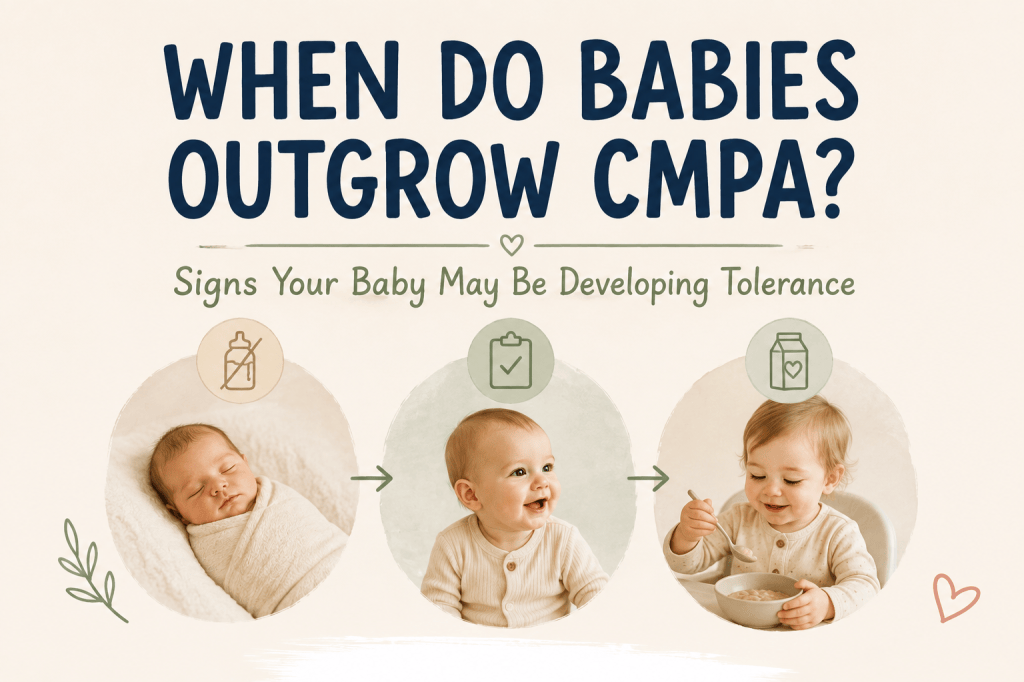
When you first realize your baby may have cow’s milk protein allergy, most of your attention goes toward one thing: Making your baby feel better. You remove dairy. You learn how to read ingredient labels. You worry about accidental exposures. You watch poop, reflux, skin, feeding, sleep, and seemingly every other thing your baby does. Eventually, though, something changes. Your baby gets older. Symptoms may improve. Starting solids arrives. And instead of wondering only: “How do we manage CMPA?” you start wondering: “When does this end?” Or, more specifically: “When do babies outgrow CMPA?” The encouraging answer is that many children with cow’s milk allergy eventually develop tolerance to cow’s milk. But there isn’t one birthday when CMPA suddenly disappears. Some children develop tolerance earlier than others, and the timeline can differ depending on the type of cow’s milk allergy, previous reactions, other allergic conditions, and the individual child. Even more importantly, a baby seeming better while avoiding dairy doesn’t necessarily prove that the allergy has disappeared. So how do you know? Let’s look at what developing tolerance actually means, what parents may notice along the way, and how healthcare professionals determine whether it’s appropriate to reassess cow’s milk.
👉 If you’re still early in the elimination process, read: [The Cow’s Milk Protein Allergy Elimination Diet While Breastfeeding: A Complete Step-by-Step Guide].
What Does “Outgrowing CMPA” Actually Mean?
When parents say their baby has “outgrown” CMPA, they’re generally talking about the development of tolerance to cow’s milk protein. In simple terms, the child can consume an amount and form of cow’s milk protein that previously caused a reaction without developing the same allergic symptoms. But tolerance isn’t always an instant switch from: Allergic → Not allergic For some children, the process can be more gradual. A child may tolerate certain extensively heated forms of milk before tolerating less-heated forms. Another child may need continued avoidance before reassessment. And a child with a history of immediate allergic reactions may follow a very different medical pathway from a baby whose symptoms were delayed. That’s one reason comparing your baby’s CMPA timeline with another baby’s can be misleading.
When Do Babies Usually Outgrow CMPA?
There isn’t one reliable age that applies to every baby. Cow’s milk allergy often improves during childhood, and many affected children eventually become tolerant. However, the timing varies considerably. The type of cow’s milk allergy matters. Broadly, cow’s milk allergy can involve IgE-mediated reactions, non-IgE-mediated reactions, or sometimes mixed patterns. Non-IgE-mediated reactions are generally delayed. IgE-mediated reactions usually occur more quickly after exposure and can potentially be serious. These aren’t simply two names for the same experience. They can behave differently over time and may require different approaches to determining whether tolerance has developed. Your pediatrician or allergist can help determine when reassessment makes sense for your child.
Why Can’t I Just Try Dairy and See What Happens?
This is incredibly tempting. Your baby has been doing great. Months have passed. They’re older. Maybe they accidentally ate something containing milk and nothing obvious happened. So why not give them some dairy and find out? Because your baby’s previous reaction history matters. For some children, healthcare professionals may eventually recommend a structured home reintroduction. For others, particularly children with a history of immediate reactions, testing or a medically supervised oral food challenge may be more appropriate. You don’t want to discover the difference by accident. Before intentionally reintroducing cow’s milk protein, ask the healthcare professional managing your baby’s allergy how they want tolerance reassessed.
👉 Read: [When Can I Try Dairy Again While Breastfeeding? What Moms Need to Know About Reintroduction].
Does Having No Symptoms Mean CMPA Is Gone?
Not necessarily. This is probably one of the biggest misunderstandings surrounding elimination diets. Suppose your baby’s symptoms disappeared after cow’s milk protein was removed. That’s exactly what you hoped would happen. But if the trigger remains absent, the lack of symptoms doesn’t tell you whether your baby would now tolerate it. Think about it this way: No exposure + no symptoms isn’t necessarily the same thing as: Exposure + no symptoms That’s why improvement during avoidance and demonstrated tolerance after appropriate reassessment are two different things.
👉 Seeing improvement? Read: [Signs Your Dairy-Free Diet Is Actually Working (Even Before Symptoms Fully Disappear)].
Are There Signs My Baby May Be Developing Tolerance?
Parents understandably want a checklist: Five signs your baby’s CMPA is disappearing. Unfortunately, tolerance can’t reliably be diagnosed from a collection of everyday behaviors. There are, however, changes that may lead parents to start asking whether reassessment is appropriate. For example, your baby may:
Five signs your baby’s CMPA is disappearing. Unfortunately, tolerance can’t reliably be diagnosed from a collection of everyday behaviors. There are, however, changes that may lead parents to start asking whether reassessment is appropriate. For example, your baby may:
- Have been symptom-free for a substantial period while following their recommended diet
- Be older than when CMPA was originally identified
- Be growing and developing well
- Have had an accidental exposure without the reaction you previously expected
- Have tolerated a form of milk protein that their healthcare professional intentionally introduced
- Be approaching a planned reassessment recommended by their pediatrician or allergist
But none of these independently proves that CMPA has resolved. Even an accidental exposure that causes no obvious reaction doesn’t necessarily establish unrestricted tolerance. It can, however, be useful information to tell your baby’s healthcare professional.
👉 If your child still needs to avoid dairy as they grow, read [How to Make Sure Your Dairy-Free Baby Gets Enough Calcium] for practical ways to support calcium intake while cow’s milk remains off the menu.
What If My Baby Accidentally Had Dairy and Was Fine?
This is where things become interesting. Maybe your baby grabbed a bite of someone else’s food. Maybe you discovered afterward that something contained milk. Maybe you accidentally ate dairy while breastfeeding. And then… Nothing happened. Naturally, you start wondering: “Does this mean the CMPA is gone?” Maybe your baby’s tolerance has changed. But one symptom-free accidental exposure isn’t enough to create your own reintroduction plan. The amount of milk protein, form of milk, route of exposure, and your baby’s allergy history can all matter. Write down what happened and discuss it with your healthcare professional. It may be useful information when deciding whether formal reassessment is appropriate.
“Does this mean the CMPA is gone?” Maybe your baby’s tolerance has changed. But one symptom-free accidental exposure isn’t enough to create your own reintroduction plan. The amount of milk protein, form of milk, route of exposure, and your baby’s allergy history can all matter. Write down what happened and discuss it with your healthcare professional. It may be useful information when deciding whether formal reassessment is appropriate.
👉 If accidental dairy normally causes symptoms for your baby, read: [Why Symptoms Return After Accidental Dairy Exposure (What to Expect)].
What If Accidental Dairy Still Causes Symptoms?
Then your baby may not yet tolerate that exposure. That doesn’t mean CMPA will necessarily be permanent. Tolerance can change as children grow. If your baby reacts during an accidental exposure, follow the allergy or medical plan you’ve been given and tell your healthcare professional what happened. Don’t intentionally repeat an exposure simply to confirm it yourself.
Can a Baby Tolerate Baked Milk but Still Have CMPA?
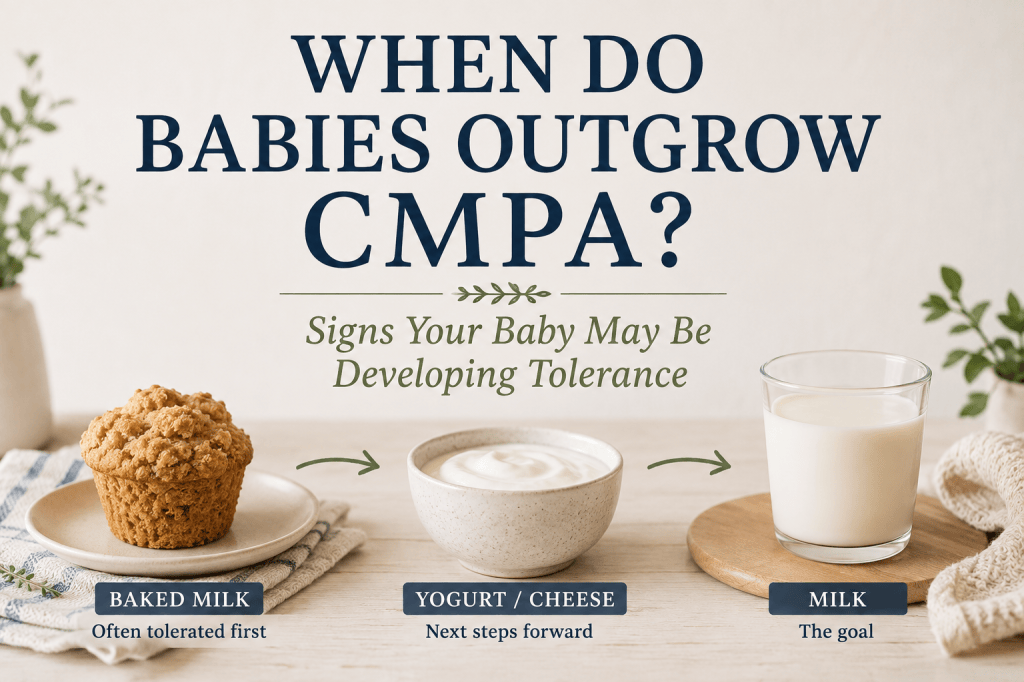
Yes, some children can tolerate certain extensively heated forms of cow’s milk while reacting to less-heated forms. That’s one reason the idea of tolerance can be more complicated than simply asking: “Can my baby have dairy — yes or no?” The form of cow’s milk protein can matter. Healthcare professionals may sometimes use a structured progression to assess this in appropriate children. That’s where you may hear about the milk ladder.
👉 Read: [What Is the Milk Ladder? A Simple Guide for Parents of Babies With CMPA].
Importantly, tolerating baked milk doesn’t automatically mean your baby should be given unrestricted dairy. Follow the progression recommended for your child.
Starting Solids Can Bring This Question to the Surface
Before solids, dairy avoidance may have primarily affected the breastfeeding parent’s diet or the type of formula being used. Once your baby starts eating directly, CMPA becomes much more visible. You’re reading labels for your baby. You’re preparing family meals. You’re thinking about daycare. And you’re watching other babies eat yogurt and cheese. It’s completely understandable to start wondering when your child might be able to eat those foods too. But being developmentally ready for solids and being medically ready for cow’s milk protein are different things. Your baby can have a wonderfully varied complementary diet while cow’s milk is still being avoided.
👉 Read: [CMPA and Starting Solids: What Parents Need to Know Before Baby’s First Foods].
Don’t Treat Tolerance Like a Deadline
It can be difficult watching another child with CMPA start eating dairy while yours still needs to avoid it. But there’s no prize for being the first baby to reach unrestricted dairy. The goal isn’t: Get dairy back as quickly as possible. The goal is: Determine what your child can safely tolerate and make sure their diet remains nutritionally appropriate along the way. Your baby’s timeline is their timeline. And as frustrating as that uncertainty can be, developing tolerance is something that should be assessed, not guessed.
Determine what your child can safely tolerate and make sure their diet remains nutritionally appropriate along the way. Your baby’s timeline is their timeline. And as frustrating as that uncertainty can be, developing tolerance is something that should be assessed, not guessed.
How Do Doctors Know When a Baby Has Outgrown CMPA?
This is where things become more concrete. Parents often expect there to be a test that simply says:
CMPA: YES
or
CMPA: NO
Unfortunately, it isn’t always that straightforward. How your baby’s healthcare professional evaluates developing tolerance depends partly on the type of cow’s milk allergy your baby has and their previous reaction history. That may involve reviewing:
- Your baby’s original symptoms
- How quickly symptoms occurred after exposure
- Previous allergy testing, if appropriate
- How long cow’s milk has been avoided
- Growth and development
- Other allergic conditions
- Any accidental exposures
- Whether certain forms of milk have already been tolerated
- Your baby’s current age and health
From there, your baby’s healthcare professional can determine whether and how cow’s milk should be reassessed.
👉 If your baby still needs to avoid cow’s milk as they get older, read [What Milk Can a Baby With CMPA Drink? Formula, Breast Milk & Milk Alternatives Explained] for help understanding formula and dairy-free milk options by age.
IgE-Mediated vs. Non-IgE-Mediated CMPA Matters
We’ve mentioned this distinction throughout our CMPA articles because it becomes especially important during reintroduction.
IgE-Mediated Cow’s Milk Allergy
IgE-mediated reactions generally occur relatively quickly after exposure. Depending on the child, symptoms can involve hives, swelling, vomiting, breathing symptoms, or other signs of an immediate allergic reaction. Because potentially serious reactions can occur, intentional reintroduction may require guidance from an allergist and sometimes a medically supervised food challenge.
Non-IgE-Mediated Cow’s Milk Allergy
Non-IgE-mediated symptoms tend to be delayed. Depending on the condition involved, symptoms may affect the digestive system, skin, feeding, or other areas. Traditional allergy testing may not provide the same information for these delayed reactions. Healthcare professionals may instead rely more heavily on the clinical history, response to elimination, and appropriately planned reintroduction. This distinction is one reason copying another parent’s dairy-reintroduction plan from social media can be problematic. Their baby’s CMPA may not be the same as yours.
👉 Still unsure how CMPA is diagnosed? Read: [How Is Cow’s Milk Protein Allergy Diagnosed in Breastfed Babies? What Parents Can Expect].
Can an Allergy Test Tell Me Whether CMPA Is Gone?
Sometimes allergy testing can provide useful information, particularly with IgE-mediated allergy. But the answer isn’t simply: Negative test = dairy is safe. Nor does a positive test always tell you exactly how a child will react if they eat a food. Allergy testing needs to be interpreted alongside the child’s clinical history by a qualified healthcare professional. And for many non-IgE-mediated cow’s milk reactions, standard skin-prick or blood testing may not be the primary way tolerance is assessed. That’s why testing should answer a specific clinical question rather than being used as a do-it-yourself screening tool.
What Is an Oral Food Challenge?
An oral food challenge is one method healthcare professionals can use to determine whether someone currently reacts to a particular food. Rather than parents simply giving an unrestricted serving of dairy at home, a medically supervised challenge uses a defined clinical protocol with observation for reactions. Whether your child needs a supervised challenge depends on their history. Not every child with CMPA will require the same approach. Some lower-risk reintroductions may be managed differently under professional guidance. But children with a history suggesting an immediate or potentially serious reaction may need specialist involvement.
What About the Milk Ladder?
For some children, particularly in certain non-IgE-mediated cow’s milk allergy situations, healthcare professionals may recommend a structured milk ladder. Rather than jumping immediately to unrestricted cow’s milk, the approach can move through different forms of milk protein. The important word there is: Structured. A milk ladder isn’t simply: “Give the baby a little dairy and see what happens.” Different ladders may use particular foods and preparation methods, and not every child is an appropriate candidate.
👉 Read our complete guide: [What Is the Milk Ladder? A Simple Guide for Parents of Babies With CMPA].
What If My Baby Passes One Stage but Not the Next?
This is one reason “outgrowing CMPA” isn’t always a perfectly clean transition. A child might tolerate one form of cow’s milk protein but react when exposed to another form. If you’re following a healthcare-guided reintroduction plan and symptoms appear at a later stage, follow the instructions you’ve been given. Don’t assume: “They tolerated the earlier food, so this reaction can’t be dairy.” And don’t assume: “They reacted now, so all our previous progress was meaningless.” Instead, think of tolerance as information. Your baby may currently tolerate some forms or amounts while not yet tolerating others. Your healthcare professional can tell you what that means for your child’s diet.
“They reacted now, so all our previous progress was meaningless.” Instead, think of tolerance as information. Your baby may currently tolerate some forms or amounts while not yet tolerating others. Your healthcare professional can tell you what that means for your child’s diet.
Does Tolerating Dairy Through Breast Milk Mean My Baby Has Outgrown CMPA?
Not necessarily. This is particularly relevant for breastfeeding families. Suppose you previously avoided dairy because your baby developed symptoms while breastfeeding. Later, you eat something containing dairy and your baby doesn’t appear to react. That’s encouraging information. But exposure through breast milk isn’t identical to your baby directly eating a cow’s-milk-containing food. So don’t assume that tolerating maternal dairy automatically means your baby is ready for unrestricted direct dairy consumption. Tell your healthcare professional what happened and ask what they recommend next.
Can CMPA Come Back After It Goes Away?
Parents sometimes describe a baby who appeared to tolerate dairy and then developed symptoms again later. There can be several possible explanations. Perhaps the child tolerated one form or amount of dairy but not another. Perhaps the original symptoms weren’t caused exclusively by cow’s milk. Perhaps a new symptom has an unrelated cause. Or perhaps the child’s allergy needs to be reassessed. A symptom appearing after dairy doesn’t automatically prove CMPA has returned. Likewise, one symptom-free exposure doesn’t necessarily prove it has permanently disappeared. This is why patterns and clinical evaluation matter more than isolated events.
👉 We cover this specifically in: [Can Cow’s Milk Protein Allergy Come Back After It Goes Away? (What Parents Should Know)].
What If My Baby’s Symptoms Return During Reintroduction?
If you’re following a reintroduction plan from your baby’s healthcare professional, they should tell you what to do if symptoms return. Follow those instructions rather than continuing to increase exposure. Keep track of:
- What your baby ate
- Approximately how much was eaten
- When it was eaten
- What symptoms appeared
- How long after eating they appeared
- How long they lasted
- Any other new foods or illnesses around the same time
That information can make your follow-up conversation much more useful. And remember: Stopping because symptoms returned isn’t failing the milk ladder or failing reintroduction. You’ve learned something about your baby’s current tolerance.
Could Symptoms After Dairy Be Something Else?
Absolutely. This can be difficult after months of managing CMPA because you naturally become extremely alert to symptoms. Baby has loose poop? Dairy. Red cheeks? Dairy. Wakes three times? Dairy. Spits up? Dairy. But babies experience symptoms for countless reasons. Teething, infections, changes in solid foods, constipation, reflux, eczema triggers, and ordinary developmental changes can overlap with symptoms parents associate with CMPA. The timing, pattern, reproducibility, and your baby’s original history all matter. If you’re unsure whether something represents an allergic reaction, discuss it with your healthcare professional rather than repeatedly eliminating foods on your own.
Be Careful About Expanding the Elimination Diet
This is worth emphasizing because food restrictions can snowball. A symptom returns. So you remove dairy. It continues. You remove soy. Then egg. Then wheat. Eventually both you and your baby may have a heavily restricted diet without knowing which foods actually matter. There are situations where multiple food allergies exist. But additional elimination should have a reason behind it. If your baby’s symptoms aren’t behaving the way you expected, that’s a reason to reassess the situation — not necessarily a reason to keep removing foods indefinitely.
What If My Baby Still Has CMPA After Their First Birthday?
A birthday doesn’t make CMPA disappear overnight. Some children will still require cow’s milk avoidance after infancy. If that’s your baby, the nutritional side becomes increasingly important as their diet changes. Your pediatrician, allergist, or pediatric dietitian can help determine:
- Whether dairy avoidance is still necessary
- When tolerance should be reassessed
- Which dairy alternatives are appropriate
- Whether nutritional supplementation is needed
- How to meet calcium, vitamin D, protein, fat, and other nutritional needs
There’s no reason to view reaching age one with CMPA as something going wrong. Your child simply may not have developed full tolerance yet.
Should We Keep Rechecking?
If your child continues to have cow’s milk allergy, their healthcare team may periodically reassess whether the allergy is persisting. Exactly when and how often depends on the child’s type of allergy, previous reactions, age, test results when relevant, and clinical history. That’s much better than choosing arbitrary dates yourself. Instead of thinking: “It’s been three months. Maybe I’ll try dairy again.” ask: “When would you like us to reassess cow’s milk tolerance?” Then you know what the plan actually is. “It’s been three months. Maybe I’ll try dairy again.” ask: “When would you like us to reassess cow’s milk tolerance?” Then you know what the plan actually is.
Don’t Let Fear Prevent Reassessment Either
We’ve talked a lot about not reintroducing dairy too quickly. But there’s another side to this. After watching your baby struggle, the idea of deliberately revisiting the food you worked so hard to remove can be scary. You may think: They’re doing great dairy-free. Why would I risk changing anything? That’s understandable. But unnecessary long-term food avoidance isn’t necessarily the goal either. When your baby’s healthcare professional believes reassessment is appropriate, finding out what your child can safely tolerate can help guide their diet going forward. CMPA management isn’t about avoiding cow’s milk forever at all costs. It’s about avoiding it for as long as medically necessary and reassessing tolerance appropriately as your child grows.
What Happens Once My Baby Outgrows CMPA?
After months of dairy avoidance, reaching the point where your child can safely tolerate cow’s milk can feel enormous. Suddenly, foods you’ve spent months checking and avoiding may become possibilities again. But even after a successful healthcare-guided reintroduction or food challenge, ask what your child’s healthcare professional wants you to do next. Depending on your child’s situation, they may provide guidance about keeping tolerated forms of dairy in the diet or continuing a particular progression. Don’t assume you need to immediately go from dairy-free to unlimited dairy. The goal is simply to follow the plan that’s appropriate for your child.
Should Dairy Stay in the Diet Once It’s Tolerated?
If your baby’s healthcare professional determines that a form of dairy is tolerated, ask whether they want that food to remain part of your child’s regular diet. This is particularly relevant if your child has progressed through a structured reintroduction plan. Rather than deciding on your own to stop and restart dairy repeatedly, follow the maintenance guidance you’ve been given. And remember that tolerating one form of milk protein may not necessarily mean every form has been cleared. Your healthcare professional can tell you exactly what your child is currently able to eat.
Can Mom Eat Dairy Again Too?
For breastfeeding moms, this might be the moment you’ve been waiting for. You may have spent months avoiding: Pizza. Cheese. Butter. Cream. Restaurant desserts. Your favorite coffee creamer. And countless foods containing hidden milk ingredients. So when your baby’s tolerance begins changing, naturally you’re going to wonder: “Can I finally eat dairy again?” Possibly. But maternal dairy exposure through breast milk and your baby’s direct consumption of dairy aren’t exactly the same thing. If you eliminated dairy specifically because of your breastfed baby’s CMPA, ask your healthcare professional when your own restriction is no longer necessary. Once they’ve told you dairy can return to your diet, you don’t need to remain dairy-free simply because you’ve gotten used to eating that way.
What If I’m Nervous About Bringing Dairy Back?
That’s completely understandable. You’ve spent months treating dairy as something that could make your baby feel miserable. Then suddenly you’re being told it may be time to find out whether things have changed. That can feel strange. You don’t have to pretend you’re not nervous. Ask questions. Make sure you understand the plan. Know what symptoms your healthcare professional wants you to watch for. And understand what you’re supposed to do if symptoms appear. Having a clear plan can make reintroduction feel much less uncertain.
👉 Read: [When Can I Try Dairy Again While Breastfeeding? What Moms Need to Know About Reintroduction].
Frequently Asked Questions About Babies Outgrowing CMPA
Do Most Babies Outgrow CMPA?
Many children with cow’s milk allergy eventually develop tolerance, although the timing varies. Some children tolerate cow’s milk earlier than others, and the type of allergy and individual medical history can influence the course. Your baby’s healthcare professional can give you a more individualized idea of when reassessment may be appropriate.
What Age Does CMPA Usually Go Away?
There isn’t one age when CMPA disappears. Some children develop tolerance during early childhood, while others continue to have cow’s milk allergy longer. Instead of waiting for a particular birthday, follow the reassessment schedule recommended by your baby’s healthcare team.
Can CMPA Go Away at 6 Months?
It’s possible for tolerance to change during infancy, but reaching 6 months doesn’t automatically mean CMPA has resolved. Six months is also around the time many babies begin complementary foods, which can make parents especially curious about dairy. Starting solids and being ready for cow’s milk reintroduction are separate decisions.
👉 Read: [CMPA and Starting Solids: What Parents Need to Know Before Baby’s First Foods].
Can CMPA Go Away at 12 Months?
Some children may have developed tolerance by around this stage, while others will continue to require cow’s milk avoidance. Turning one shouldn’t be used as an automatic signal to introduce cow’s milk following a diagnosed allergy. Ask your child’s healthcare professional how they want tolerance reassessed.
How Do I Know If My Baby Has Outgrown CMPA?
You generally can’t confirm that simply because your baby has been symptom-free while avoiding dairy. Appropriate reintroduction, testing when clinically relevant, or a medically supervised food challenge may be used depending on the type of allergy and your child’s history. Your healthcare professional should determine the appropriate method.
Can CMPA Suddenly Disappear?
Tolerance can develop as children grow, but parents may not notice the exact moment that happens because the food causing the allergy is usually being avoided. That’s why periodic reassessment can be important.
Does an Accidental Dairy Exposure Without Symptoms Mean CMPA Is Gone?
Not necessarily. It can be encouraging and worth discussing with your baby’s healthcare professional, but the amount and form of milk protein involved matter. One symptom-free exposure doesn’t automatically establish unrestricted tolerance.
If My Baby Can Eat Baked Milk, Have They Outgrown CMPA?
Not necessarily. Some children may tolerate extensively heated milk while still reacting to less-heated forms. Follow the reintroduction plan recommended for your child.
👉 Read: [What Is the Milk Ladder? A Simple Guide for Parents of Babies With CMPA].
Can CMPA Come Back?
Symptoms can sometimes appear again after a child seemed to be tolerating dairy, but that doesn’t automatically mean an allergy disappeared and then returned. The amount or form of dairy may have changed, the symptom may have another cause, or the child’s allergy may need reassessment.
👉 Read: [Can Cow’s Milk Protein Allergy Come Back After It Goes Away? What Parents Should Know].
Does CMPA Last Longer in Breastfed Babies?
Breastfeeding itself doesn’t provide a simple timeline for when an individual child will develop tolerance. Your baby’s allergy type, medical history, previous reactions, and individual development matter more than comparing breastfed and formula-fed babies.
Should I Keep My Baby Dairy-Free Just to Be Safe?
Continue avoidance for as long as your baby’s healthcare professional recommends. But indefinite avoidance without reassessing whether it’s still necessary isn’t automatically safer. When your healthcare professional believes it’s appropriate, reassessing tolerance can help determine what your child actually needs to avoid.
Your Baby’s CMPA Story Will Eventually Change
When you’re in the middle of dairy-free breastfeeding, CMPA can feel enormous. It affects breakfast. Coffee. Grocery shopping. Restaurants. Family gatherings. Ingredient labels. Starting solids. Daycare. And probably far too many late-night Google searches. But your baby’s needs at three months aren’t necessarily going to be their needs at one year. And their needs at one year aren’t necessarily going to be their needs at three years. The goal isn’t to become permanently excellent at avoiding dairy. The goal is to respond appropriately to what your child needs at each stage. Sometimes that means strict avoidance. Sometimes it means waiting. Sometimes it means reassessment. And eventually, for many families, it means discovering that cow’s milk protein can return.
Final Thoughts
So, when do babies outgrow CMPA? There isn’t one universal timeline. Many children eventually develop tolerance to cow’s milk protein, but the timing and appropriate method of reassessment depend on the individual child. What parents shouldn’t rely on is guesswork.
A symptom-free baby who’s avoiding dairy hasn’t necessarily demonstrated tolerance. An accidental exposure without symptoms can be encouraging without proving that unrestricted dairy is safe. And tolerating baked milk doesn’t necessarily mean every form of dairy is tolerated. Instead, work with your baby’s pediatrician, allergist, or dietitian to answer three questions: Is it time to reassess? How should we reassess? What should we do with the result? Those questions are much more useful than trying to predict the exact month when CMPA will disappear. And if your baby isn’t ready yet? That doesn’t mean they never will be. It simply means you’re still somewhere along the journey.
Is it time to reassess? How should we reassess? What should we do with the result? Those questions are much more useful than trying to predict the exact month when CMPA will disappear. And if your baby isn’t ready yet? That doesn’t mean they never will be. It simply means you’re still somewhere along the journey.
You May Also Enjoy
👉 When Can I Try Dairy Again While Breastfeeding? What Moms Need to Know About Reintroduction
👉 What Is the Milk Ladder? A Simple Guide for Parents of Babies With CMPA
👉 CMPA and Starting Solids: What Parents Need to Know Before Baby’s First Foods
👉 Signs Your Dairy-Free Diet Is Actually Working (Even Before Symptoms Fully Disappear)
👉 When Will My Baby Feel Better After Going Dairy-Free? What to Expect Week by Week
👉 Why Symptoms Return After Accidental Dairy Exposure (What to Expect)
👉 How Is Cow’s Milk Protein Allergy Diagnosed in Breastfed Babies? What Parents Can Expect
👉 Can Cow’s Milk Protein Allergy Come Back After It Goes Away? What Parents Should Know
Medical Disclaimer
The information in this article is intended for educational and informational purposes only and should not be considered medical advice, diagnosis, or a personalized allergy-management or dairy-reintroduction plan. Cow’s milk protein allergy can vary significantly between children. The timing and method used to reassess tolerance depend on factors including the type of allergy, previous reactions, severity, age, test results when relevant, and individual medical history. Do not intentionally reintroduce cow’s milk protein, begin a milk ladder, or perform a food challenge solely based on information in this article. Speak with your child’s pediatrician, allergist, dietitian, or another qualified healthcare professional to determine when and how cow’s milk should be reassessed. Children with a history of immediate or potentially serious allergic reactions may require specialist assessment or medically supervised food challenges. Seek urgent medical care for potentially serious or rapidly developing allergic symptoms. Never delay or disregard professional medical advice because of information you have read on this website.






Leave a comment