
Baby Still Has CMPA Symptoms After Cutting Dairy? Here’s What to Check You stopped putting milk in your coffee. You gave up cheese. You started checking labels. You’ve been reading ingredient lists in the grocery store while holding a baby who would very much like you to stop reading ingredient lists. And yet your baby is still having symptoms. Maybe they’re still uncomfortable after feeds. Maybe their diapers haven’t returned to what you expected. Maybe reflux, skin symptoms, fussiness, or another issue that originally led you toward cow’s milk protein allergy hasn’t completely disappeared. At that point, it’s easy to think one of two things: “I must be doing the dairy-free diet wrong” or “This must not be CMPA.” Neither conclusion is necessarily correct. Improvement after removing cow’s milk protein isn’t always immediate, and different symptoms don’t necessarily resolve on exactly the same timeline. At the same time, persistent symptoms deserve attention because there are several possibilities to consider—including hidden milk exposure, an incomplete elimination, another dietary trigger, an unrelated medical issue, or an initial CMPA assumption that needs to be reassessed. This article isn’t going to tell you to start cutting more and more foods until your diet consists of chicken and rice. Instead, we’ll work through the possibilities systematically.
👉 If you’re just beginning elimination, start with [The Cow’s Milk Protein Allergy Elimination Diet While Breastfeeding: A Complete Step-by-Step Guide].
First: How Long Have You Actually Been Dairy-Free?
If you stopped eating dairy yesterday and your baby still has symptoms today, that doesn’t necessarily tell you much. Parents sometimes hear that dairy takes a specific number of hours, days, or weeks to “leave the system,” but the reality is more complicated than a single countdown clock. The timing of dietary proteins, symptom improvement, and healing aren’t all the same thing. Some symptoms may change relatively quickly while others can take longer to settle. Your baby’s original symptoms, the type of suspected CMPA, ongoing exposures, and other factors can all affect what you observe. This is why it’s useful to distinguish between “My baby hasn’t improved at all” and “My baby is improving, but isn’t completely symptom-free yet.” Those are different situations.
👉 For a deeper explanation of timing, read [How Long Does Dairy Stay in Breastmilk? Evidence-Based Timeline].
Look for the Trend, Not One Bad Day
Babies aren’t machines. Even when an elimination diet is helping, every diaper won’t necessarily look identical, every feeding won’t be peaceful, and your baby won’t suddenly stop being fussy forever. A better question is whether the overall pattern is improving. Are difficult feeds becoming less frequent? Is your baby’s skin looking better overall? Are concerning diaper symptoms decreasing? Does your baby generally seem more comfortable than before the elimination began? One difficult afternoon doesn’t necessarily mean the diet failed. Likewise, one great day doesn’t prove cow’s milk protein was definitely the cause. Patterns over time are much more useful than individual moments.
Check Whether Dairy Has Actually Been Fully Eliminated
This is one of the first practical things to review. Cutting dairy means more than avoiding obvious foods such as milk, cheese, yogurt, and ice cream. Cow’s milk ingredients can appear in breads, crackers, sauces, seasoning mixes, baked goods, chocolate, snack foods, processed meats, restaurant foods, and many other products. Ingredients such as whey, casein, caseinates, milk powder, milk solids, butter, cream, cheese, and buttermilk can all matter when cow’s milk protein needs to be avoided. That doesn’t mean you need to become terrified of everything in your pantry. It means that before deciding the elimination “isn’t working,” make sure you’re actually doing the elimination you intended to do.
Don’t Confuse Lactose-Free With Dairy-Free
This mistake is incredibly easy to make, especially when you’re new to CMPA. CMPA is not lactose intolerance. Lactose is a sugar found in milk. Cow’s milk protein allergy involves proteins found in cow’s milk. Removing lactose doesn’t necessarily remove those proteins. That means a product labeled “lactose-free” may still be completely inappropriate for a cow’s-milk-protein elimination diet. If you’ve switched to lactose-free cow’s milk, lactose-free cheese, or another lactose-free dairy product thinking you’ve removed cow’s milk protein, that could explain why the elimination isn’t accomplishing what you expected.
👉 Read [Dairy Allergy vs Lactose Intolerance in Breastfed Babies (What Is the Difference)] if you’re unsure about this distinction.
Check Packaged Foods You’ve Been Eating Regularly
You don’t need to investigate every blueberry you’ve eaten during the past month. Start with the foods you eat most often. Your daily bread. Coffee creamer. Protein bars. Crackers. Breakfast cereal. Margarine or spreads. Chocolate. Prepared sauces. Seasoning blends. Restaurant orders. Supplements or other products you’ve specifically been told to consider by your healthcare professional. If one of those contains cow’s milk protein and you eat it every day, finding that exposure is much more useful than obsessing over a food you ate once three weeks ago. This is also why a simple food record can sometimes help. You don’t necessarily need a complicated spreadsheet. A basic record of what you’re eating and what you’re observing can make patterns easier to discuss with your baby’s healthcare professional.
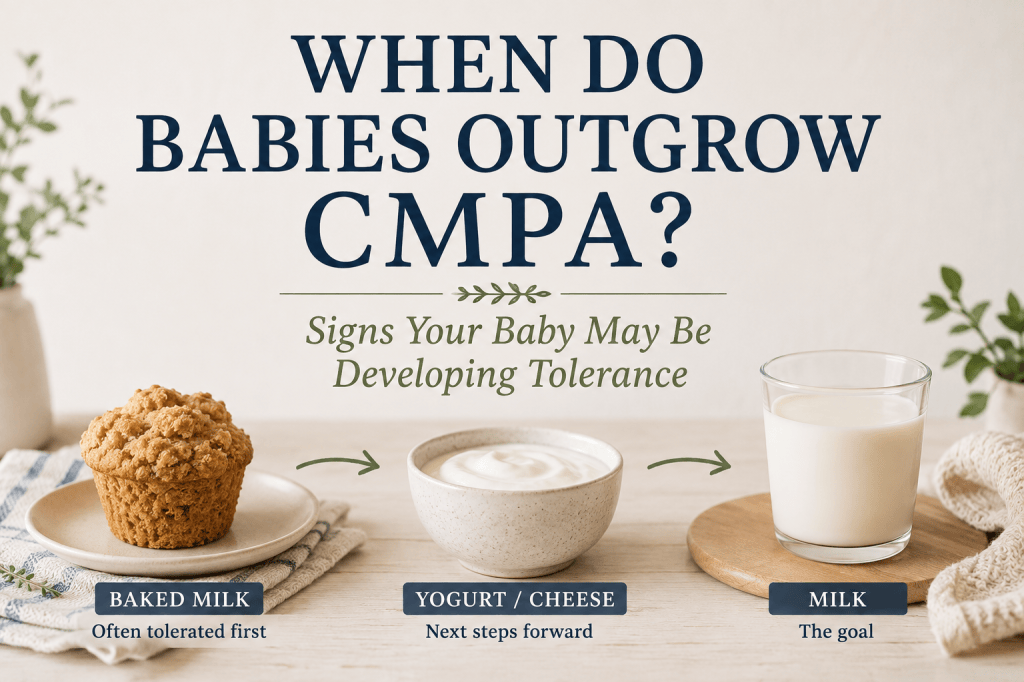
👉 If symptoms eventually settle, the next question is often how long CMPA will last. Read [When Do Babies Outgrow CMPA? Signs Your Baby May Be Developing Tolerance] for what happens as babies get older.
What About “May Contain Milk”?
Precautionary statements such as “may contain milk” are different from milk being intentionally included in the ingredient list. They generally relate to the possibility of allergen cross-contact during manufacturing.
Whether you need to avoid products with precautionary milk statements depends on your baby’s allergy history and the guidance you’ve received from their healthcare professional. Don’t automatically assume that “may contain” means exactly the same thing as milk appearing as an ingredient—but don’t assume it’s irrelevant for every child either. This is particularly important if your baby has a history of immediate or more serious allergic reactions, where individualized allergist guidance matters.
👉 For the full explanation, read [“May Contain Milk” vs “Made in a Facility”: What Dairy-Free Breastfeeding Moms Need to Know].
Could You Be Getting Dairy at Restaurants?
Possibly. Restaurant meals are one of the harder places to identify hidden milk because you don’t control the recipe or preparation. Vegetables may be finished with butter. Meat may be cooked in butter. Bread can contain milk. Sauces may contain cream. Mashed potatoes commonly contain dairy. Eggs may be prepared with milk, cheese, or butter. If you’re still troubleshooting symptoms, think about how often you’re eating food prepared outside your home and whether you’re clearly communicating the need to avoid cow’s milk ingredients. That doesn’t mean every restaurant meal is secretly contaminated with dairy. It simply means restaurant exposure belongs on the checklist when you’re trying to figure out why an elimination hasn’t produced the expected result.
What If You Accidentally Ate Dairy?
Accidental exposures happen. You misread a label. A restaurant misunderstood you. Someone told you a dish was dairy-free and later realized it contained butter. You ate something you’ve purchased for months and discovered the ingredients changed. Don’t interpret one mistake as proof that you’ve “ruined everything” and need to restart some imaginary countdown from zero. Instead, note the exposure, follow whatever plan you’ve been given for your baby’s CMPA, and continue the elimination. If your baby has a history of serious or immediate reactions, follow their individualized allergy or emergency plan and contact their healthcare professional as appropriate. The goal is consistency—not perfection.
👉 If your baby’s CMPA symptoms seem better but sleep is still a struggle, don’t assume the elimination diet has failed. Read [Can CMPA Affect Baby Sleep? Why Your Baby May Be Waking So Often] to understand why sleep may improve with CMPA treatment but can also remain completely separate from the allergy.
Is It Actually Cow’s Milk Protein Allergy?
This question deserves to be asked, especially when symptoms aren’t improving. Many symptoms associated with CMPA can also occur for other reasons. Reflux, crying, changes in stool, skin issues, feeding difficulty, and general fussiness aren’t unique to cow’s milk protein allergy. That’s one reason diagnosing CMPA can sometimes be challenging, particularly with delayed gastrointestinal symptoms. If a properly followed elimination hasn’t produced the expected improvement, don’t simply assume your baby has an unusually stubborn case of CMPA. Their pediatrician may need to reconsider the original diagnosis or investigate other explanations. This isn’t a failure of the elimination diet. It’s useful information.
Don’t Immediately Cut Soy, Egg, Wheat, and Everything Else
This is where parents can get trapped. Dairy didn’t fix everything, so soy disappears. A week later egg disappears. Then wheat. Then corn. Then nuts. Before long, you’re eating an extremely restricted diet without knowing whether any of those foods were actually causing a problem. Some babies genuinely have more than one food allergy or intolerance. Soy, for example, can be relevant for some babies with certain presentations. But CMPA doesn’t automatically mean soy allergy, egg allergy, or multiple-food allergy. Additional elimination should have a reason behind it and ideally be discussed with your baby’s healthcare professional or dietitian.
👉 Before automatically removing soy, read [Do I Have to Cut Out Soy Too While Dairy-Free Breastfeeding? (What Most Moms Don’t Know)].
What If Your Baby Is Formula-Fed or Combination-Fed?
If your baby receives formula in addition to or instead of breast milk, your own dairy elimination isn’t the only exposure that matters. Some babies with diagnosed CMPA who require formula need an appropriate specialized infant formula. Standard cow’s-milk-based formula, lactose-free formula, and products marketed simply as “gentle” or “sensitive” aren’t automatically appropriate for cow’s milk protein allergy. The specific formula needed depends on the baby’s individual situation and should be determined with their healthcare professional.
👉 Read [What Milk Can a Baby With CMPA Drink? Formula, Breast Milk & Milk Alternatives Explained] for a complete explanation.
Improvement Doesn’t Always Mean Every Baby Symptom Disappears
This may be one of the hardest expectations to reset. Babies spit up. Babies cry. Babies wake at night. Their stool changes as they grow. Their skin can develop rashes for reasons completely unrelated to food. Starting solids changes digestion again. A successful CMPA elimination doesn’t turn your baby into a symptom-free robot. What you’re looking for is improvement in the specific pattern of symptoms that led to the CMPA evaluation, along with appropriate growth, feeding, and overall health. If you’re unsure whether what you’re seeing represents meaningful improvement, that’s a very reasonable question to bring to your baby’s pediatrician.
Could Soy Be the Reason Symptoms Aren’t Improving?
Soy is usually one of the first foods parents hear about when dairy elimination doesn’t seem to be enough. That’s partly because some babies with cow’s milk protein allergy may also react to soy, particularly in certain non-IgE-mediated gastrointestinal conditions. But that doesn’t mean dairy-free automatically needs to become dairy-and-soy-free. If your baby’s symptoms aren’t improving as expected, soy is one possibility to discuss with their pediatrician or dietitian, but it’s not the only possibility. Before removing it, make sure cow’s milk protein has actually been eliminated consistently and that enough time has passed to reasonably evaluate the response. If your healthcare professional does recommend a soy elimination, make sure you understand exactly what you’re testing, how long the trial should last, what improvement you’re looking for, and how the diagnosis will eventually be confirmed or reassessed. Otherwise, it’s easy to eliminate soy indefinitely without ever knowing whether it mattered.
👉 Before removing soy, read [Do I Have to Cut Out Soy Too While Dairy-Free Breastfeeding? (What Most Moms Don’t Know)].
Could Egg Be Causing Symptoms Too?
Egg is another common allergen, but CMPA doesn’t automatically mean egg allergy. Removing egg simply because dairy elimination hasn’t completely resolved symptoms can create the same problem as unnecessarily removing soy: your diet becomes increasingly restrictive without clear evidence that the additional restriction is helping. If there’s a consistent pattern associated with egg exposure or another reason your baby’s healthcare professional suspects egg, that’s different. Egg can then be evaluated on its own rather than being treated as an extension of CMPA.
👉 We cover this distinction in [Can Babies With CMPA Eat Eggs? Dairy vs. Egg Allergy Explained].
Could Breast Milk Itself Be the Problem?
Parents sometimes reach this point after weeks of elimination and wonder whether they should stop breastfeeding altogether.
CMPA doesn’t mean your baby is allergic to human breast milk. The concern in a breastfed baby is exposure to small amounts of dietary cow’s milk proteins that may be present after the breastfeeding parent consumes cow’s milk products. If your baby isn’t improving, don’t assume breast milk needs to disappear. First review the elimination, the diagnosis, your baby’s symptoms, growth, and any other feeding sources with their healthcare professional. For many families, breastfeeding can continue while CMPA is evaluated and managed. Decisions about stopping breastfeeding or making major changes to your baby’s feeding plan should be based on your baby’s individual situation rather than fear that breast milk itself has somehow become unsafe.
Do You Need to Switch to Formula?
Not automatically. If you’re breastfeeding and your baby has suspected or diagnosed CMPA, persistent symptoms don’t necessarily mean specialized formula will solve the problem or that breastfeeding has failed. There are situations where formula supplementation or replacement may be medically appropriate, and babies with CMPA who require formula may need a specialized product. But that’s a decision to make with your baby’s healthcare professional. Don’t independently replace breast milk with ordinary lactose-free, “sensitive,” goat’s-milk, or plant-based beverages in an attempt to solve CMPA symptoms.
What If My Baby’s Poop Still Doesn’t Look Normal?
Baby poop causes an enormous amount of CMPA anxiety because parents naturally use diapers as one of the few things they can actually observe. But there isn’t one universal “perfect CMPA recovery poop.” Stool appearance varies with age, feeding method, medications, illness, and eventually solid foods. Even healthy babies can have considerable variation in color and consistency. Instead of expecting every diaper to suddenly look identical, pay attention to the specific concerning features that originally led to evaluation and whether those are improving. If your baby’s stool continues to contain blood, or you’re seeing another persistent or concerning change, contact their pediatrician rather than continuing to modify your own diet indefinitely.
👉 For more help understanding diapers, read [CMPA Baby Poop: What It Can Look Like and When to Call the Pediatrician].
What If Mucus Is Still There?
Mucus is another symptom that can become frustrating because parents may continue seeing it even after other things seem better. Mucus in stool isn’t specific to CMPA and can occur for different reasons. Its significance depends on the larger clinical picture: your baby’s age, feeding, growth, other symptoms, whether blood is present, and what your pediatrician has already diagnosed. If your baby seems substantially better overall but you’re still seeing occasional mucus, that situation is different from a baby who continues having significant gastrointestinal symptoms, feeding problems, poor growth, or blood in the stool. Don’t use mucus alone as a reason to remove another five foods from your diet.
What If Reflux Isn’t Going Away?
Reflux can be associated with CMPA in some babies, but reflux is also extremely common in infancy and can occur without food allergy. That means dairy elimination may improve reflux in a baby whose symptoms are related to cow’s milk protein without necessarily eliminating every spit-up. If your expectation is “CMPA treatment should mean my baby never spits up again,” you may incorrectly conclude that the elimination failed. Look at the overall pattern. Is feeding more comfortable? Is your baby growing appropriately? Has distress improved? Are other symptoms changing? Persistent, severe, worsening, or otherwise concerning reflux deserves medical evaluation rather than progressively stricter maternal elimination.
What If My Baby Is Still Gassy?
Gas is another symptom that isn’t specific to CMPA. Babies swallow air while feeding, their digestive systems are developing, and normal digestion produces gas. If significant gas appeared alongside other symptoms and improves during elimination, that may be useful information. But a baby passing gas after dairy elimination doesn’t mean hidden milk must still be getting through somewhere. This is why diagnosing and monitoring CMPA based on one vague symptom can become misleading. The entire symptom pattern matters.
What If the Rash Is Still There?
Skin symptoms can take time to improve, and not every baby rash is caused by food allergy. Eczema, irritation, heat, saliva, infection, contact reactions, and other conditions can all affect a baby’s skin. If a rash isn’t improving as expected, have it evaluated rather than assuming more dietary elimination is the answer. Your baby may need appropriate skin treatment in addition to—or instead of—dietary changes. Similarly, don’t judge whether an elimination diet works solely by one patch of irritated skin while ignoring improvement everywhere else.
How Do I Know If Going Dairy-Free Is Actually Working?
This is where documenting the before and after can be surprisingly useful. Think back to the symptoms that led you to eliminate dairy in the first place. If there were five major concerns, don’t add 15 new things to the list after starting the diet. Compare the original problem with what you’re seeing now. You might keep a simple record of feeding comfort, relevant stool changes, skin symptoms, vomiting or reflux when clinically relevant, and anything else your pediatrician has asked you to monitor. You don’t need to score every cry or photograph every diaper. You’re looking for an overall pattern that can help answer: Is my baby meaningfully better than before?
What If My Baby Improved and Then Symptoms Came Back?
This is an important scenario because it’s different from never improving at all. If your baby clearly improved during cow’s milk elimination and symptoms later returned, consider what changed. Was there an accidental dairy exposure? Did you introduce a new food? Did the baby start formula? Did you change a regular packaged product? Did your baby become sick? Did they start solids? Is there another explanation entirely? A return of symptoms doesn’t automatically mean CMPA suddenly became worse. Look for changes around the same time rather than assuming the elimination has stopped working.
Starting Solids Can Complicate the Picture
If your baby begins complementary foods during this process, you suddenly have a lot more variables. Before solids, you’re primarily evaluating breast milk, formula, and the breastfeeding parent’s diet. After solids begin, your baby is directly eating new foods. That doesn’t mean solids should be delayed indefinitely. It means introducing foods thoughtfully and keeping track of new exposures becomes more useful when you’re already managing a food allergy.
👉 If you’re approaching this stage, read [CMPA and Starting Solids: What Parents Need to Know Before Baby’s First Foods].
Don’t Blame Every New Symptom on the Last Food
Once you’ve dealt with CMPA, it’s incredibly easy to become hyperaware of everything that happens after your baby eats. Baby ate banana at 10:00. Baby was fussy at noon. Was it banana? Baby ate egg yesterday. Rash today. Egg allergy? Baby had soy three days ago. Bad diaper today. Soy? Timing matters in food allergy, but so do the type of symptoms, reproducibility, other exposures, illness, and the child’s medical history. A symptom occurring after a food doesn’t automatically prove the food caused it. If you suspect another food, document what happened and discuss it with your baby’s healthcare professional rather than immediately adding it to a permanent avoidance list.
When Should I Call the Pediatrician Again?
If you’ve followed the elimination plan you were given and your baby isn’t improving as expected, that’s a good reason to follow up. You should also contact your baby’s healthcare professional for persistent or worsening symptoms, feeding difficulties, concerns about hydration or growth, ongoing blood in stool, significant vomiting, or anything else that worries you about your baby’s health. For rapidly developing symptoms that could represent a serious allergic reaction—particularly breathing difficulty, significant swelling, marked lethargy or collapse, or multiple severe symptoms occurring together—seek emergency medical care. The important point is that persistent symptoms shouldn’t lead only to more Googling and more food elimination. At some point, the diagnosis and treatment plan need to be reassessed.
Your Pediatrician May Need to Reconsider the Diagnosis
This isn’t bad news. If your baby doesn’t respond to a correctly performed elimination in the way expected, that information helps narrow down what’s happening. Your baby’s symptoms might have another cause. CMPA may still be present alongside another issue. The elimination may need to be reviewed. The original diagnosis may need confirmation. A pediatric gastroenterologist, allergist, or pediatric dietitian may sometimes be useful depending on the situation. The goal isn’t to prove that your original CMPA suspicion was correct. The goal is to figure out why your baby is having symptoms and what actually helps them.
More Restriction Isn’t Automatically Better Treatment
This is the trap I most want you to avoid. A diet containing no dairy, soy, egg, wheat, corn, nuts, and several other foods isn’t inherently “more healing” than a dairy-free diet. It’s simply more restrictive. Sometimes multiple eliminations are medically appropriate. But every additional restriction should have a reason, because breastfeeding parents need adequate calories, protein, vitamins, minerals, and dietary variety too. If your elimination diet is becoming increasingly narrow, especially if you’re struggling to eat enough or you’re unsure how to replace important nutrients, ask for help from a qualified dietitian rather than continuing to remove foods indefinitely. The objective isn’t to eat as few foods as possible. It’s to identify and appropriately manage the actual problem.
A Simple “Why Isn’t My Baby Better Yet?” Checklist
When you’ve removed dairy and symptoms are still hanging around, it helps to stop guessing and work through the possibilities one at a time. Ask yourself: How long have we been following the elimination plan? Have obvious and hidden sources of cow’s milk protein actually been removed? Are we accidentally using lactose-free dairy instead of dairy-free products? Is my baby also receiving formula or solids that could contain milk? Did symptoms improve at all, even if they haven’t disappeared? Have there been accidental exposures? Did anything else change around the same time? If you’ve worked through those questions and your baby still isn’t improving as expected, the next step usually isn’t randomly eliminating another food. It’s bringing that information back to your baby’s healthcare professional.
What Does Improvement Actually Look Like?
Improvement doesn’t necessarily mean waking up one morning with a completely different baby. Depending on the symptoms involved, changes may happen gradually and at different speeds. You may notice feeds becoming more comfortable, concerning stool symptoms decreasing, skin improving, or your baby generally seeming more settled. Another symptom may take longer or may turn out not to have been related to CMPA in the first place. That’s why looking at the original symptom pattern is so useful. You’re trying to determine whether removing cow’s milk protein produced a meaningful clinical change, not whether your baby has achieved some imaginary state of perfect digestion.
Don’t Keep Changing the Experiment
One of the easiest ways to make an elimination trial impossible to interpret is changing five things at once. You remove dairy on Monday. Soy on Thursday. Egg the following Monday. Then you change formula, start a probiotic, remove gluten, and introduce several new solid foods. If your baby improves, what helped? You may have no idea. When medically appropriate, changing one meaningful variable at a time makes the response much easier to evaluate. If your baby’s symptoms require faster intervention, their healthcare professional can determine the appropriate plan rather than relying on trial and error.
Does Dairy Need to Be Reintroduced to Confirm CMPA?
This is an important part of CMPA diagnosis that sometimes gets lost online. With some forms of suspected CMPA, improvement during elimination alone may not be enough to confidently establish that cow’s milk protein caused the symptoms. A planned reintroduction or oral food challenge may sometimes be used to determine whether symptoms return when cow’s milk protein is reintroduced. That matters because many common infant symptoms improve naturally over time. If dairy is removed and the baby improves several weeks later, it’s tempting to assume dairy was definitely responsible—but timing alone doesn’t always prove causation. However, reintroduction isn’t something every family should attempt independently at home. Whether it should happen at home or under medical supervision depends on the baby’s reaction history and type of suspected allergy. Babies with a history suggesting immediate or potentially serious reactions require individualized medical guidance.
👉 If you’re reaching this stage, read [When Can I Try Dairy Again While Breastfeeding? What Moms Need to Know About Reintroduction].
Don’t Stay Dairy-Free Forever Without Reassessment
Once dairy-free eating becomes normal, it’s surprisingly easy to continue indefinitely. But if you removed cow’s milk because of suspected CMPA, there should eventually be a plan for reassessing whether avoidance is still necessary. That might involve confirming the diagnosis after an elimination trial or, later, evaluating whether your child has developed tolerance. Unnecessary long-term elimination has downsides. It makes eating more difficult, can increase grocery costs, and requires attention to nutrients that dairy foods may otherwise provide. Avoid cow’s milk protein for as long as your baby’s medical plan requires—not simply because you’re afraid to ever try it again.
What If Dairy Reintroduction Makes Symptoms Return?
If cow’s milk protein is reintroduced according to an appropriate medical plan and the same relevant symptoms return, that information can help support the diagnosis. What happens next depends on your baby’s age, allergy type, symptoms, and medical history. Your healthcare professional may recommend continuing avoidance for another period before reassessing tolerance. Don’t repeatedly challenge your baby at home after a concerning reaction just to gather more evidence.
What If Dairy Reintroduction Doesn’t Cause Symptoms?
That information is useful too. If an appropriately planned reintroduction is tolerated, your healthcare professional may determine that continued strict cow’s milk avoidance isn’t necessary or may guide you through further introduction. That’s one reason confirmation matters. The goal isn’t to keep your baby dairy-free at all costs. The goal is to determine whether cow’s milk protein is actually causing a problem and manage it appropriately.
When Does the Milk Ladder Come Into This?
The milk ladder is a structured way of introducing progressively less-heated forms of cow’s milk protein and may be used for some children with certain types of CMPA when their healthcare professional determines that reintroduction is appropriate. It isn’t appropriate for every child, and it isn’t simply a DIY test to see whether a baby is “still allergic.” A child’s previous reactions and allergy type matter when deciding whether a milk ladder is appropriate and where reintroduction should occur.
Common Mistakes When a Dairy-Free Diet Doesn’t Seem to Work
One mistake is expecting every symptom to disappear immediately. Another is accidentally continuing to consume cow’s milk protein through hidden ingredients or assuming lactose-free products are suitable for CMPA. But the opposite problem happens too: parents become too restrictive. If dairy doesn’t solve everything, they remove soy. Then egg. Then wheat. Eventually the diet becomes so complicated that it’s difficult to maintain and nearly impossible to determine which elimination actually mattered. Another mistake is changing too many things simultaneously. If you change diet, formula, medications, supplements, feeding technique, and solids all at once, you may never know what actually changed your baby’s symptoms. And finally, don’t become so committed to the CMPA explanation that every persistent symptom has to fit it. Sometimes the most useful conclusion from an unsuccessful elimination is that the original diagnosis deserves another look.
Frequently Asked Questions
How Long After Cutting Dairy Should My Baby Improve?
There’s no single timeline that applies to every symptom and every baby. Some changes may be noticed sooner than others, while gastrointestinal or skin symptoms may take longer to settle. Follow the elimination period recommended by your baby’s healthcare professional and evaluate the overall symptom pattern rather than expecting one precise day when everything disappears.
Why Is My Baby Still Fussy After I Cut Dairy?
Fussiness isn’t specific to CMPA. Even if cow’s milk protein was contributing to your baby’s symptoms, removing it doesn’t eliminate all the normal reasons babies cry or become unsettled. If fussiness is persistent, severe, worsening, associated with feeding difficulty or poor growth, or simply concerns you, discuss it with your baby’s pediatrician rather than assuming hidden dairy must be responsible.
Why Is My Baby Still Spitting Up After Cutting Dairy?
Spit-up and reflux are common during infancy and can occur with or without CMPA. Dairy elimination may improve symptoms when cow’s milk protein is contributing, but it doesn’t necessarily mean a baby will stop spitting up entirely.
Why Is There Still Mucus in My Baby’s Poop?
Mucus isn’t specific to CMPA and needs to be interpreted alongside the rest of your baby’s symptoms and medical history. Occasional mucus in an otherwise improving baby is a different situation from persistent concerning stool changes accompanied by feeding problems, blood, poor growth, or significant illness.
Could I Still Be Eating Hidden Dairy?
Yes, which is why checking frequently eaten packaged and prepared foods is worthwhile. Look for intentionally added milk ingredients rather than focusing only on obvious dairy foods such as cheese and yogurt.
👉 See [50 Hidden Sources of Dairy (Even Dairy-Free Moms Miss These)] for help checking your diet.
Do I Need to Cut Soy Too?
Not automatically. Some babies may also need to avoid soy, but CMPA doesn’t mean every baby requires a dairy-and-soy-free diet. If a properly performed cow’s-milk elimination hasn’t produced the expected response, discuss whether soy or another explanation should be investigated with your baby’s healthcare professional rather than removing it indefinitely on your own.
Should I Cut Eggs Too?
Again, not automatically. Egg is a separate allergen from cow’s milk.
Should I Stop Breastfeeding?
CMPA doesn’t automatically mean breastfeeding needs to stop. If you’re breastfeeding and your baby isn’t improving as expected, review the diagnosis, elimination diet, other feeding sources, and symptoms with their healthcare professional before making a major feeding change.
Could My Baby Need a Different Formula?
Possibly, if your baby receives formula and has diagnosed CMPA. The appropriate formula depends on the individual baby, and ordinary lactose-free or “sensitive” formulas aren’t automatically appropriate for cow’s milk protein allergy. Formula changes for suspected or diagnosed CMPA should be discussed with your baby’s healthcare professional.
Could Something Other Than CMPA Be Causing the Symptoms?
Yes. Reflux, crying, stool changes, rashes, feeding difficulties, and many other symptoms associated with CMPA can have other causes. That’s one reason a lack of improvement after an appropriately conducted elimination deserves medical reassessment rather than endless dietary restriction.
You Haven’t “Failed” the Elimination Diet If Your Baby Isn’t Better
An elimination trial isn’t supposed to produce a predetermined answer. It’s supposed to give you information. If your baby improves substantially after cow’s milk protein is removed, that’s useful information that can be interpreted alongside their history and, when appropriate, subsequent reintroduction. If your baby doesn’t improve, that’s useful information too. It may tell your healthcare professional to look for hidden exposure, reconsider another dietary trigger, investigate a different condition, or question whether CMPA was actually responsible for the symptoms. The objective isn’t to prove CMPA. The objective is to understand what’s happening with your baby.
Final Thoughts
If your baby still has CMPA symptoms after you’ve cut dairy, don’t immediately assume you need to eliminate more foods.
Start by reviewing the basics. Make sure cow’s milk protein has actually been removed, check frequently eaten packaged foods, understand the difference between lactose-free and dairy-free, consider formula and direct food exposures, and look at your baby’s overall symptom trend rather than individual bad days. If the elimination has been followed appropriately and your baby still isn’t improving as expected, bring that information back to their healthcare professional. Soy or another food may sometimes need consideration. But so might an unrelated condition or an incorrect initial assumption about CMPA. And eventually, when medically appropriate, the diagnosis itself may need to be confirmed or cow’s milk tolerance reassessed. More restriction isn’t automatically better treatment. Better information is.
You May Also Enjoy
👉 The Cow’s Milk Protein Allergy Elimination Diet While Breastfeeding: A Complete Step-by-Step Guide
👉 How Long Does Dairy Stay in Breastmilk? Evidence-Based Timeline
👉 50 Hidden Sources of Dairy (Even Dairy-Free Moms Miss These)
👉 Dairy Allergy vs Lactose Intolerance in Breastfed Babies (What Is the Difference?)
👉 Do I Have to Cut Out Soy Too While Dairy-Free Breastfeeding? (What Most Moms Don’t Know)
👉 Can Babies With CMPA Eat Eggs? Dairy vs. Egg Allergy Explained
👉 CMPA Baby Poop: What It Can Look Like and When to Call the Pediatrician
👉 When Can I Try Dairy Again While Breastfeeding? What Moms Need to Know About Reintroduction
👉 What Is the Milk Ladder? A Simple Guide for Parents of Babies With CMPA
Medical Disclaimer
The information in this article is intended for educational and informational purposes only and isn’t a substitute for individualized medical, allergy, nutritional, or feeding advice. Symptoms commonly associated with cow’s milk protein allergy can also occur for other reasons, and persistent symptoms require appropriate medical evaluation.
If your baby has suspected or diagnosed CMPA and isn’t improving as expected, contact their pediatrician, allergist, pediatric gastroenterologist, dietitian, or another qualified healthcare professional before significantly expanding an elimination diet, changing formula, stopping breastfeeding, or intentionally reintroducing cow’s milk protein. Do not intentionally challenge a baby with a food that has previously caused a suspected immediate or serious allergic reaction unless a qualified healthcare professional has determined that doing so is appropriate and provided instructions. Seek urgent medical care for potentially serious or rapidly developing allergic symptoms, breathing difficulty, significant swelling, marked lethargy or collapse, or other symptoms suggesting a medical emergency. Never delay or disregard professional medical advice because of information you have read on this website.





Leave a comment