You have been carefully avoiding dairy while breastfeeding, and then it happens. Maybe you discover milk buried in an ingredient list after you’ve already eaten the food. Maybe a restaurant meal wasn’t as dairy-free as you thought. Or perhaps you intentionally ate dairy as part of a reintroduction plan. Then your baby becomes unusually fussy, has a different-looking diaper, spits up more than usual, develops a skin symptom, or simply seems uncomfortable. The obvious question is: Did the dairy I ate actually cause this?
For parents of babies with suspected or diagnosed cow’s milk protein allergy (CMPA), this can be surprisingly difficult to answer. Cow’s milk proteins from a mother’s diet can result in food-derived proteins or fragments being detectable in breast milk, but there isn’t a reliable countdown that tells every parent exactly when a baby will react after the mother eats dairy. Symptoms, timing, the type of milk allergy, the amount of exposure, and the baby’s individual response can all vary. That means one difficult evening after eating dairy doesn’t automatically prove a reaction occurred, but a consistent pattern can provide useful information to discuss with your baby’s healthcare provider.
Can a Breastfed Baby Really React to Dairy Mom Eats?
Yes, some exclusively or partially breastfed babies can react to cow’s milk proteins associated with the breastfeeding mother’s diet, although this appears to affect only a small proportion of breastfed infants. This is very different from lactose intolerance. CMPA involves an immune response to proteins in cow’s milk, while lactose is the naturally occurring sugar in milk. A breastfeeding mother’s body digests the food she eats, and food-derived proteins or fragments can sometimes be detected in breast milk. In a susceptible baby, exposure may contribute to symptoms.
This does not mean breast milk itself is harmful or that breastfeeding needs to stop. When a breastfed infant truly has cow’s milk allergy and maternal dietary elimination is appropriate, breastfeeding can generally continue while the mother removes cow’s milk protein under appropriate medical or nutritional guidance.
👉 Confused about milk protein versus lactose? Read [Dairy Allergy vs Lactose Intolerance in Breastfed Babies: What Is the Difference?].
How Quickly Could My Baby React After I Eat Dairy?
This is one of the biggest questions parents have, and unfortunately there isn’t a universal answer such as “dairy reaches breast milk in exactly two hours and disappears after 24 hours.” Research examining food proteins in human milk has found considerable variation between people and studies. The presence and concentration of food-derived proteins in breast milk aren’t identical from one mother to another, and detecting a protein in milk doesn’t automatically tell us whether a particular baby will develop symptoms.
The baby’s type of allergic reaction matters too. IgE-mediated reactions tend to occur relatively quickly after the baby is exposed to the allergen, while non-IgE-mediated food-allergy symptoms can be delayed and harder to connect to a single exposure. This is one reason parents managing suspected non-IgE CMPA can have such a difficult time figuring out whether yesterday’s meal caused today’s symptoms.
Rather than relying on an exact number of hours, it is more useful to look for a repeatable relationship between exposure and symptoms.
👉 For a deeper look at what happens after an accidental exposure, read [Why Symptoms Return After Accidental Dairy Exposure: What to Expect].
What Might a Dairy Reaction Through Breast Milk Look Like?
There isn’t one symptom that proves a breastfed baby reacted to cow’s milk protein. Depending on the type of allergy and the individual baby, possible symptoms can involve the gastrointestinal tract, skin, feeding, and, particularly with immediate IgE-mediated allergy, other body systems. Parents dealing with suspected non-IgE CMPA may notice changes such as gastrointestinal discomfort, vomiting or reflux-like symptoms, feeding difficulty, or blood or mucus in the stool. Other babies may have skin symptoms such as eczema, although eczema alone doesn’t establish a food allergy.
Immediate symptoms such as hives, swelling, repetitive vomiting, coughing, wheezing, difficulty breathing, or other rapidly developing symptoms require a different level of concern because they may indicate an immediate allergic reaction. Serious or rapidly progressing allergic symptoms require urgent medical attention according to the child’s emergency plan.
The key point is that many possible CMPA symptoms are also common in babies who don’t have CMPA. Reflux, gas, crying, eczema, unusual diapers, and poor sleep all have numerous possible causes. Seeing one of them after eating dairy doesn’t automatically establish cause and effect.
The Pattern Matters More Than One Symptom
Suppose you accidentally eat dairy on Tuesday. Your baby has an unusually fussy Wednesday and a diaper with more mucus than you’re accustomed to seeing. Was dairy responsible? Possibly. But one event gives us limited information. Babies have bad days. Stool changes. Sleep changes. They can develop minor illnesses, swallow more air during feeds, experience normal digestive changes, or become fussy for reasons that have absolutely nothing to do with your lunch.
Now imagine a different situation. Dairy is removed under your baby’s healthcare provider’s guidance and several previously persistent symptoms improve. Later, during an appropriate reintroduction or accidental exposure, the same collection of symptoms returns in a similar pattern. That repeated relationship is much more informative than one isolated diaper or one restless night.
This is also why elimination followed by appropriate reintroduction can be important in diagnosing many cases of non-IgE cow’s milk allergy. Improvement while dairy is removed is useful information, but improvement followed by recurrence with re-exposure can provide much stronger evidence that cow’s milk protein was actually involved.
👉 For the complete process, read [The Cow’s Milk Protein Allergy Elimination Diet While Breastfeeding: A Complete Step-by-Step Guide].
What If My Baby’s Poop Changes After I Eat Dairy?
Poop is one of the first things parents monitor because it provides something visible to compare. If your baby previously had blood or mucus associated with suspected CMPA, you may naturally inspect every diaper after an accidental exposure. A recurrence of a previously established stool pattern could be relevant, particularly when it occurs alongside other symptoms, but one unusual diaper doesn’t confirm a milk reaction.
Breastfed baby stool naturally varies in color, frequency, texture, and consistency. Mucus can occur for reasons other than CMPA, and visible blood in an infant’s stool has several possible causes that should be discussed with a pediatrician rather than automatically attributed to dairy.
👉 If you’re trying to interpret what you’re seeing, read [Milk Allergy Baby Poop Pictures: Colors and What Each Type Could Mean].
This also leads directly into an important question we’ll cover in the next article in this five-post series: what should CMPA poop actually do after dairy is eliminated?
What If My Baby Becomes Fussy, Gassy or Refluxy?
These symptoms are even harder to interpret because they are extraordinarily common during infancy. A baby becoming gassy or fussy after a maternal dairy exposure may fit into an established CMPA pattern, but fussiness itself isn’t evidence of food allergy. The same applies to reflux. Cow’s milk allergy can sometimes contribute to gastrointestinal symptoms that resemble or accompany reflux, but most infant reflux isn’t automatically caused by dairy.
This is where knowing your baby’s baseline pattern becomes useful. If a particular collection of symptoms consistently disappeared during an elimination period and then clearly returned after cow’s milk protein was reintroduced, that information is much more meaningful than noticing that your baby spit up after one feeding.
👉 If reflux is one of the main symptoms you’re tracking, read [Silent Reflux vs Normal Baby Reflux: How to Tell the Difference].
Could a Rash Tell Me My Baby Reacted?
Sometimes skin symptoms occur with food allergy, but the type and timing matter. Hives that appear rapidly following allergen exposure are very different from chronic eczema that gradually becomes better or worse over days. Eczema and food allergy frequently coexist, but eczema isn’t automatically caused by cow’s milk protein. Babies can also develop rashes from heat, illness, saliva, detergents, skincare products, contact irritation, and many other causes.
If your baby develops a new rash after suspected dairy exposure, take note of when it appeared, what it looked like, what else the baby was exposed to, and whether other symptoms occurred. A photograph can also be useful to show your pediatrician or allergist if the rash disappears before the appointment.
👉 We’ve also covered why food allergy and eczema can overlap in [Can Eczema Lead to Food Allergies in Babies? The Skin Barrier Connection].
Should I Start the Dairy-Free Timeline Over?
Usually, an accidental exposure doesn’t mean everything you’ve accomplished has suddenly been erased or that you’re literally back at “day one.” If cow’s milk protein triggers symptoms in your baby, an exposure may cause symptoms to recur or temporarily interrupt improvement, but that is different from saying the entire elimination process has been reset.
The more useful approach is to return to your established dairy-free plan, document what happened, and watch the overall symptom trend rather than trying to calculate a new countdown from zero.
👉 We have a complete article answering this exact question: [I Accidentally Ate Dairy While Breastfeeding—Do I Need to Start Over?].
Should I Pump and Dump After Accidentally Eating Dairy?
For most situations involving maternal cow’s milk elimination, routinely pumping and discarding breast milk after an accidental dairy exposure isn’t a standard way to “clear” milk protein faster. Breast milk production is an ongoing biological process, not a storage tank that can simply be emptied once to remove everything associated with a food you ate.
More importantly, don’t abruptly stop breastfeeding or make major feeding changes based on an internet timeline. If your baby has a confirmed allergy with a history of significant reactions, follow the individualized plan provided by your pediatrician or allergist.
👉 For more about the timeline parents often worry about, read [How Long Does Dairy Stay in Breastmilk? Evidence-Based Timeline].
Don’t Use an Antihistamine as a Home CMPA Test
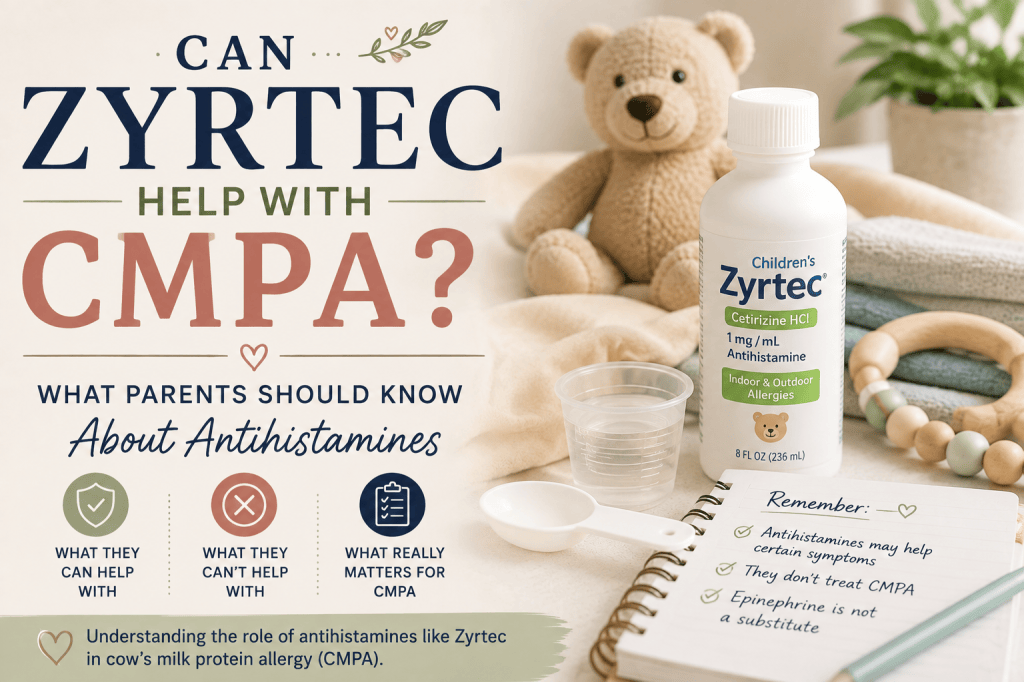
Since we just covered this topic on the blog, it fits perfectly here. A parent may wonder whether giving an antihistamine and seeing symptoms improve would prove the baby reacted to dairy. It won’t. Antihistamines can reduce certain histamine-mediated symptoms, particularly itching and hives, but they don’t treat every type of CMPA symptom and a response to medication doesn’t identify what caused the symptom.
This becomes particularly important with delayed non-IgE gastrointestinal CMPA, where the underlying reaction isn’t simply something an antihistamine can switch off.
👉 Read [Can Zyrtec Help With CMPA? What Parents Should Know About Antihistamines] before assuming an allergy medicine can confirm or reverse a milk reaction.
A Simple Symptom Diary Can Be More Useful Than Guessing
If you’re repeatedly wondering whether your baby reacted after you ate dairy, keeping a short symptom diary can make the conversation with your pediatrician much more productive. Record what you ate, when you ate it, when you first noticed symptoms, which symptoms appeared, how long they lasted, and whether they resemble the baby’s previous suspected CMPA pattern. You can also note feeds, stool changes, skin symptoms, medications, illness, and other unusual exposures when relevant.
The goal isn’t to document every minute of your baby’s life or become afraid of every diaper. It’s to determine whether a repeatable pattern actually exists. A written record is much more reliable than trying to reconstruct three weeks of feeds and symptoms from memory during a pediatric appointment.
When Should You Call the Pediatrician?
Contact your baby’s healthcare provider if symptoms are persistent, worsening, interfering with feeding or growth, involve repeated vomiting, include blood in the stool, or otherwise concern you. If your baby has already been diagnosed with CMPA, ask the healthcare team what they specifically want you to do after an accidental exposure so you’re not trying to create a plan while symptoms are occurring.
Symptoms suggesting a serious immediate allergic reaction require urgent attention. Difficulty breathing, significant swelling, collapse or unusual unresponsiveness, or rapidly progressing symptoms should be treated as an emergency. If your child has a prescribed allergy emergency plan or epinephrine, follow that plan.
The Bottom Line
There usually isn’t one symptom or exact number of hours that can tell you with certainty, “Yes, my baby reacted to the dairy I ate.” Instead, look at the entire picture: what symptoms occurred, when they appeared, whether they resemble the baby’s previous symptoms, whether other explanations are possible, and most importantly, whether the same relationship between cow’s milk exposure and symptoms happens repeatedly.
For many parents dealing with non-IgE CMPA, the pattern is more informative than the clock. One fussy evening, one reflux episode, one rash, or one strange diaper isn’t enough to prove that dairy traveled through breast milk and caused a reaction. But improvement during an appropriately managed elimination followed by a reproducible return of symptoms with re-exposure can be much more meaningful information for your baby’s healthcare provider.
And if an accidental exposure does happen, don’t assume you’ve ruined weeks of progress. Return to the plan you’ve established with your baby’s healthcare team, document what happened, and watch the overall trend. The goal isn’t perfect detective work after every meal. It’s understanding your baby’s consistent pattern over time.
Frequently Asked Questions
How long after I eat dairy could my breastfed baby react?
There isn’t one reliable timeline that applies to every breastfeeding parent and baby. Food-derived proteins can appear in breast milk differently between individuals, and the timing of symptoms also depends on the type of allergic reaction involved. Immediate IgE-mediated reactions generally develop more quickly after allergen exposure, while non-IgE CMPA symptoms can be delayed and much harder to connect to one specific meal. Instead of relying on an exact number of hours, look for a consistent and repeatable relationship between dairy exposure and your baby’s established symptoms.
Can my baby react to dairy through breast milk even if I only ate a small amount?
Potentially, but individual sensitivity varies considerably and the amount of dairy a breastfeeding mother eats doesn’t provide a reliable way to predict whether or how strongly a baby will react. If your baby has diagnosed cow’s milk allergy, follow the avoidance and accidental-exposure guidance provided by your baby’s pediatrician or allergist rather than experimenting with different amounts at home.
If my baby is fussy after I eat dairy, does that mean CMPA?
No. Fussiness is extremely common during infancy and has many possible causes. It becomes more meaningful when it occurs as part of a consistent collection of symptoms that repeatedly appears with cow’s milk exposure and improves during an appropriately managed elimination. Fussiness alone shouldn’t be used to diagnose CMPA.
Can dairy I eat cause mucus in my breastfed baby’s poop?
Cow’s milk protein allergy can be associated with gastrointestinal symptoms, including stool changes, in some breastfed babies. However, mucus isn’t specific to CMPA and can occur for other reasons. Persistent mucus, visible blood, or other concerning stool changes should be discussed with your baby’s pediatrician rather than diagnosed from diaper appearance alone.
👉 For more help understanding diaper changes, read [Milk Allergy Baby Poop Pictures: Colors and What Each Type Could Mean].
Can my baby react differently each time I’m accidentally exposed to dairy?
Symptoms aren’t necessarily identical after every exposure. The circumstances surrounding an exposure, the baby’s health, the type of reaction, and other factors can vary. That is another reason to focus on the overall pattern across multiple symptoms and exposures rather than expecting precisely the same reaction every time.
Does a reaction mean I have to stop breastfeeding?
Not necessarily. Breastfeeding can often continue when a breastfed baby has cow’s milk allergy while maternal cow’s milk protein is eliminated when medically appropriate. If your baby has experienced a significant reaction or has a confirmed allergy, ask your healthcare team for an individualized feeding and accidental-exposure plan rather than stopping breastfeeding on your own.
Do I need to pump and dump after eating dairy?
Routine pumping and dumping isn’t generally a way to instantly remove food proteins associated with something you’ve eaten. If your baby has a diagnosed allergy, follow the specific advice provided by your baby’s healthcare team.
👉 Read [How Long Does Dairy Stay in Breastmilk? Evidence-Based Timeline] for a deeper explanation of why the process isn’t as simple as emptying the breasts once.
If symptoms return after dairy exposure, have I ruined the elimination diet?
An accidental exposure may cause symptoms to recur in a susceptible baby, but it doesn’t mean that all previous progress has been erased. Return to the dairy-free plan you’ve established and watch the overall symptom trend.
👉 Read [I Accidentally Ate Dairy While Breastfeeding—Do I Need to Start Over?] for more on what happens after a slip.
Should I intentionally eat dairy to see if my baby reacts?
Don’t intentionally challenge a baby with a suspected or diagnosed food allergy without knowing whether and how your baby’s healthcare provider wants reintroduction performed. The safest approach depends on the suspected type of allergy and the baby’s reaction history. Some children may eventually undergo home reintroduction or a milk ladder under professional guidance, while others may require medically supervised testing or an oral food challenge.
Can I give my baby Zyrtec after I accidentally eat dairy?
Don’t automatically give an antihistamine simply because maternal dairy exposure occurred. Antihistamines may help certain histamine-mediated symptoms but don’t treat every type of CMPA reaction, and they aren’t substitutes for epinephrine during anaphylaxis. Follow your child’s individualized allergy plan and ask the pediatrician or allergist which medications, if any, should be used after an exposure.
👉 Read [Can Zyrtec Help With CMPA? What Parents Should Know About Antihistamines] for the full explanation.
Related Articles
Why Symptoms Return After Accidental Dairy Exposure: What to Expect
I Accidentally Ate Dairy While Breastfeeding—Do I Need to Start Over?
What Happens If You Accidentally Eat Dairy While Breastfeeding? What to Expect and What to Do Next
How Long Does Dairy Stay in Breastmilk? Evidence-Based Timeline
The Cow’s Milk Protein Allergy Elimination Diet While Breastfeeding: A Complete Step-by-Step Guide
Milk Allergy Baby Poop Pictures: Colors and What Each Type Could Mean
Can Zyrtec Help With CMPA? What Parents Should Know About Antihistamines
Medical Disclaimer
This article is for educational and informational purposes only and isn’t intended to diagnose cow’s milk protein allergy or determine whether a particular symptom was caused by something a breastfeeding mother ate. Symptoms associated with food allergy can overlap with many other infant conditions. If you suspect your baby has CMPA, are considering eliminating or reintroducing foods, or are concerned about symptoms following an exposure, speak with your baby’s pediatrician, allergist, or another qualified healthcare professional. For severe or rapidly progressing allergic symptoms, follow your child’s emergency allergy plan and seek emergency medical care.






Leave a comment