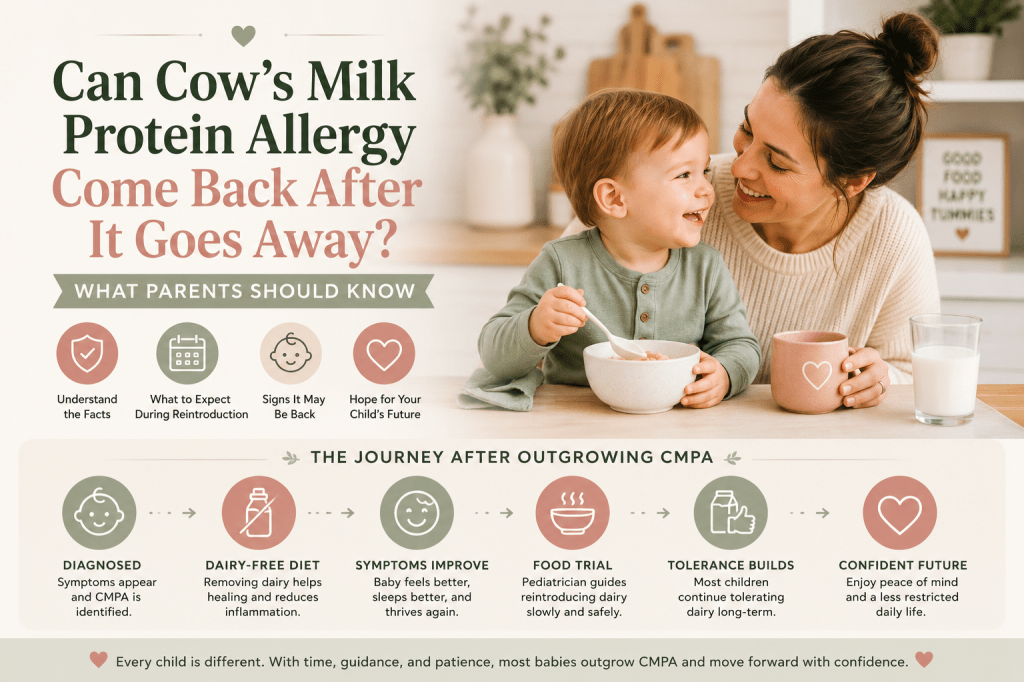
Can Cow’s Milk Protein Allergy Come Back After It Goes Away? (What Parents Should Know)
Quick Answer
Usually, no. Once a child has truly outgrown cow’s milk protein allergy (CMPA), it generally does not return. However, temporary reactions during dairy reintroduction, illnesses, or digestive changes can sometimes make it seem like the allergy has come back. Every child is different, which is why dairy should only be reintroduced under the guidance of your pediatrician or pediatric allergist.
One of the Biggest Fears Parents Have
For months, you’ve read every ingredient label.
You’ve skipped pizza nights, birthday cake, ice cream, and countless favorite foods.
You’ve celebrated every small victory as your baby’s reflux improved, the diapers finally looked normal again, and the constant crying slowly disappeared.
Then your pediatrician says something you’ve been hoping to hear for a long time:
“I think it’s time to try dairy again.”
At first, you’re excited.
Then the worry starts.
“What if the allergy comes back?”
“What if we’re back to square one?”
“Could one bad reaction undo all the progress we’ve made?”
These are completely normal questions.
The good news is that most babies who truly outgrow cow’s milk protein allergy continue tolerating dairy without the allergy returning. Understanding what normal reintroduction looks like—and what isn’t normal—can help make the process much less stressful.
👉 Before recovery comes diagnosis. Learn what researchers know about whether breastfeeding can prevent cow’s milk protein allergy in the first place. Can Breastfeeding Prevent Cow’s Milk Protein Allergy? (What the Research Actually Says)
Does Cow’s Milk Protein Allergy Usually Come Back?
In most cases, no.
Cow’s milk protein allergy is different from many lifelong food allergies because it is often something children naturally outgrow as their digestive and immune systems mature.
Once true tolerance develops, the immune system no longer reacts to milk proteins the way it did during infancy.
That doesn’t necessarily mean every dairy exposure will go perfectly the first time. Some children experience mild digestive changes while their bodies adjust again, but this isn’t always a sign that the allergy has returned.
For the majority of children who successfully pass a supervised dairy challenge, milk remains part of their diet moving forward.
Why Do Most Babies Outgrow CMPA?
During the first few years of life, your baby’s body changes remarkably quickly.
Their digestive system becomes stronger.
Their intestinal lining matures.
Their immune system learns which proteins are harmless and which require a response.
This process is called developing oral tolerance, and it’s one of the reasons many infants eventually stop reacting to cow’s milk proteins.
Unlike lactose intolerance—which involves difficulty digesting milk sugar—CMPA is an immune response. As that immune response matures, many children naturally stop viewing milk proteins as a threat.
👉 Want to learn more about how long this process usually takes? Read: How Long Does Cow’s Milk Protein Allergy (CMPA) Last in Babies? What Most Parents Can Expect
Why Some Parents Think the Allergy Came Back
This is where things become confusing.
A child who previously tolerated dairy may suddenly have:
- A loose stool
- Mild eczema
- Temporary stomach upset
- Fussiness during an illness
- Vomiting from a stomach virus
Naturally, many parents wonder:
“Is the milk allergy back?”
Most of the time, the answer is probably not.
Many childhood illnesses temporarily affect digestion.
Teething can change bowel habits.
Viruses often cause symptoms that look surprisingly similar to food sensitivities.
Because of this, pediatricians usually look at the overall pattern rather than one isolated symptom before deciding whether CMPA has truly returned.
Can Temporary Reactions Happen?
Yes.
Even after a child has outgrown CMPA, they may occasionally experience mild digestive symptoms after eating a large amount of dairy for the first time in months.
For example, your child might have:
- Mild gas
- Temporary bloating
- A softer stool
- Slight stomach discomfort
These symptoms don’t automatically mean the allergy has returned.
Think about an adult who hasn’t eaten spicy food in a year. Their stomach may protest the first meal, but that doesn’t mean they’re suddenly allergic to spicy food.
The digestive system sometimes needs a little time to adjust.
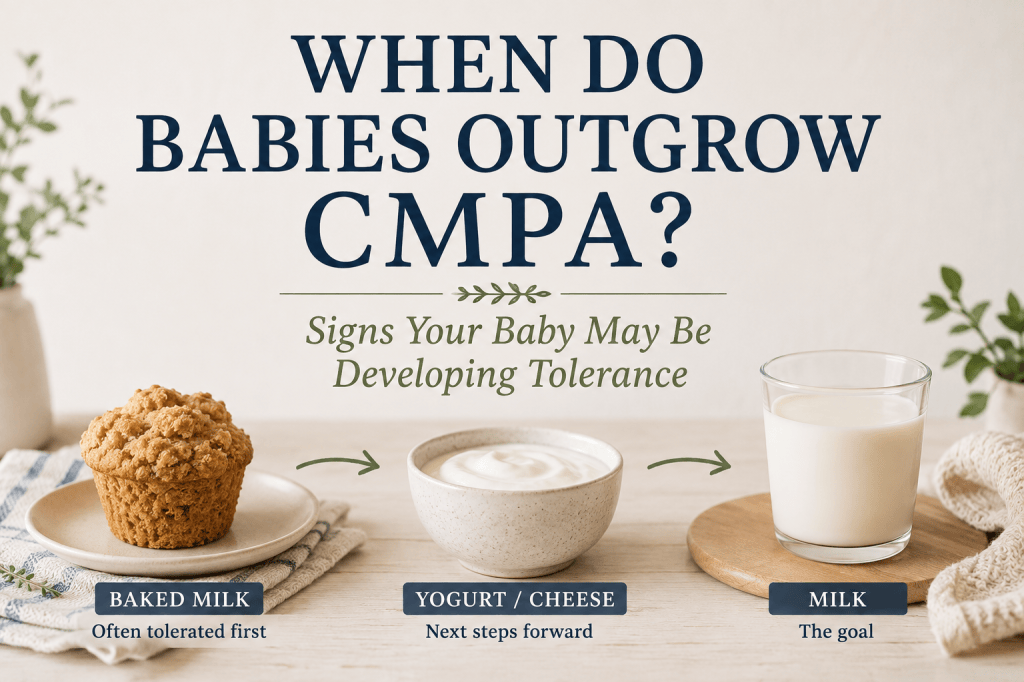
👉 Before wondering whether CMPA can return, it helps to understand how tolerance develops in the first place. Read [When Do Babies Outgrow CMPA? Signs Your Baby May Be Developing Tolerance].
When Is It More Concerning?
While occasional mild digestive symptoms are fairly common, some reactions deserve prompt medical evaluation.
Contact your pediatrician if dairy reintroduction is followed by:
- Blood in the stool
- Significant mucus
- Repeated vomiting
- Difficulty breathing
- Hives
- Swelling of the lips or face
- Severe eczema flare-ups
- Persistent diarrhea
- Poor weight gain
These symptoms don’t necessarily mean the allergy has returned, but they should always be evaluated by a healthcare professional.
👉 If you’ve noticed blood after reintroducing dairy, read: Can Dairy Cause Blood in Breastfed Baby Poop? (When to Worry and What to Do)
👉 Seeing mucus again? Read: Can Dairy in Breastmilk Cause Mucus in Babies (What It Really Means and What to Do)
How Pediatricians Usually Reintroduce Dairy
Most healthcare providers don’t recommend jumping straight from a completely dairy-free diet to large servings of milk.
Instead, reintroduction often happens gradually.
Many pediatricians recommend a structured approach that slowly increases exposure while watching for symptoms.
The exact method depends on:
- Your child’s age
- Previous reactions
- Severity of symptoms
- Growth and development
- Medical history
Following your healthcare provider’s guidance helps make the process as safe and successful as possible.
The “Milk Ladder” Explained
One reason parents sometimes believe CMPA has returned is because they expect dairy reintroduction to be an all-or-nothing event.
In reality, many pediatricians and pediatric allergists recommend introducing dairy gradually using what’s commonly called the Milk Ladder.
The idea is simple: foods containing extensively heated milk proteins are often easier to tolerate than fresh milk because heat changes the structure of the proteins.
A typical progression may look something like this:
- Baked goods containing milk
- Pancakes or muffins made with milk
- Cheese cooked into foods
- Yogurt
- Fresh milk
Not every child follows the same progression, and some children should never attempt dairy reintroduction without direct medical supervision. Always follow your healthcare provider’s recommendations.
Signs Your Child Is Developing Tolerance
Parents often expect one dramatic moment where they suddenly know their child has outgrown CMPA.
More often, it happens gradually.
Some encouraging signs include:
- Your child tolerates baked dairy without symptoms.
- Their digestion remains normal after small dairy exposures.
- Skin stays clear.
- Sleep remains unchanged.
- No reflux returns.
- Stools remain normal.
- Appetite stays consistent.
- Weight gain continues appropriately.
Rather than looking for one “perfect” day, pediatricians usually look for a consistent pattern of success over time.
What If Symptoms Return During Reintroduction?
This is where parents understandably become anxious.
A single symptom doesn’t necessarily mean the allergy has returned.
Instead, healthcare providers usually consider several factors:
- Which dairy food was introduced?
- How much was eaten?
- How quickly did symptoms appear?
- Were there other illnesses happening?
- Have symptoms repeated after multiple dairy exposures?
For example, a loose stool after a stomach virus is very different from repeated bloody stools after every dairy exposure.
Patterns matter much more than isolated events.
When a Reaction May Not Actually Be CMPA
Several common childhood issues can mimic milk protein allergy.
These include:
Viral Illnesses
Stomach viruses frequently cause diarrhea, vomiting, poor appetite, and temporary digestive upset.
Teething
Although teething itself doesn’t directly cause diarrhea, changes in eating habits and saliva production can affect stools.
Toddler Diet Changes
As children begin eating more table foods, constipation, loose stools, and occasional stomach discomfort become much more common.
Temporary Digestive Sensitivity
After months without dairy, the digestive system may simply need time to adjust again.
This adjustment is usually short-lived and doesn’t necessarily indicate an immune reaction.
Normal Adjustment vs. Possible Allergic Reaction
| Normal Adjustment | Possible Allergic Reaction |
|---|---|
| Mild gas | Blood in stool |
| One loose stool | Persistent diarrhea |
| Slight bloating | Repeated vomiting |
| Temporary stomach discomfort | Hives or swelling |
| No ongoing symptoms | Symptoms after every dairy exposure |
| Child otherwise acts normal | Poor feeding or poor weight gain |
This table isn’t intended to diagnose your child, but it can help illustrate why pediatricians evaluate the entire clinical picture rather than one isolated symptom.
Research Gives Parents Good Reason for Hope
One of the most encouraging aspects of CMPA is that the long-term outlook is generally excellent.
Research has shown that many children develop tolerance during infancy or early childhood.
That means today’s dairy-free grocery shopping, ingredient label reading, and meal planning are often temporary rather than permanent.
While every child follows their own timeline, most families eventually reach a point where dairy is no longer a daily concern.
That can feel almost impossible to imagine when you’re in the middle of sleepless nights and constant symptom tracking—but many parents who have been exactly where you are eventually find themselves looking back with relief.
Common Mistakes Parents Make
During dairy reintroduction, it’s easy to let anxiety take over.
Here are a few common mistakes that can make the process more stressful than it needs to be.
Introducing Too Much Dairy Too Quickly
A gradual approach is usually easier on both your child’s digestive system and your peace of mind.
Assuming Every Symptom Means Failure
Children get sick.
Toddlers have sensitive stomachs.
Not every digestive upset means CMPA has returned.
Skipping Medical Guidance
Every child’s allergy history is different.
Your pediatrician can help determine the safest timing and approach for reintroducing dairy.
Comparing Your Child to Others
Online forums can be helpful, but every child’s immune system develops at its own pace.
One baby may tolerate dairy before their first birthday, while another may need more time.
Neither timeline is “right” or “wrong.”
A Word of Encouragement
If you’ve been dairy-free for months, it’s completely understandable to feel nervous about moving forward.
Many parents worry that one wrong decision will erase all the progress they’ve worked so hard to achieve.
Fortunately, that’s rarely how CMPA works.
Reintroduction isn’t a test you’re expected to pass perfectly.
It’s simply another step in your child’s development—one that should happen with patience, guidance, and realistic expectations.
The goal isn’t perfection.
The goal is helping your child safely discover what their body is ready for.
What Should You Do If You Think CMPA Has Returned?
If your child develops symptoms after dairy is reintroduced, try not to jump to conclusions after one bad day.
Instead, take a step back and look at the bigger picture.
Ask yourself:
- Was this the first dairy exposure in months?
- Is my child also fighting a cold or stomach virus?
- Did the symptoms resolve quickly?
- Have they happened more than once?
- Are the symptoms mild or severe?
Keeping a simple food and symptom journal for a few weeks can be incredibly helpful. It gives your pediatrician much more information than trying to remember details from memory.
If symptoms are severe, persistent, or resemble your child’s original CMPA symptoms, contact your pediatrician before continuing dairy.
Recovery Doesn’t Always Mean a Straight Line
One thing I wish more parents were told is that recovery isn’t always perfectly smooth.
Many families expect one of two outcomes:
- Dairy works perfectly forever.
- The allergy immediately comes back.
Real life is usually somewhere in the middle.
Some children have a few minor digestive adjustments.
Others tolerate baked dairy before fresh milk.
Some need a little more time before trying again.
That doesn’t mean anyone has failed.
It simply means your child’s immune system is continuing to mature.
Progress isn’t measured by one meal.
It’s measured over months.
Quick Checklist
If you’re wondering whether your child’s CMPA has truly returned, ask yourself:
☐ Have symptoms occurred after multiple dairy exposures?
☐ Are the symptoms similar to the original allergy?
☐ Has blood or mucus returned?
☐ Is reflux becoming frequent again?
☐ Has eczema flared significantly?
☐ Has my child become unusually fussy after dairy?
☐ Has my pediatrician evaluated the new symptoms?
If you answered “yes” to several of these questions, your healthcare provider may recommend additional evaluation before continuing dairy.
Frequently Asked Questions
Can cow’s milk protein allergy come back after it’s gone?
In most children, no. Once true tolerance develops, CMPA usually does not return. However, temporary digestive changes during dairy reintroduction can sometimes be mistaken for a recurrence.
Is one bad reaction enough to know the allergy is back?
Usually not.
Pediatricians typically look for repeated reactions and overall patterns rather than one isolated episode.
Can toddlers suddenly develop CMPA again?
This is uncommon.
New digestive symptoms in toddlers are often caused by viruses, constipation, dietary changes, or temporary stomach sensitivities rather than a return of infant CMPA.
What if my child tolerated dairy yesterday but reacts today?
One isolated reaction doesn’t necessarily mean the allergy has returned.
Your pediatrician may recommend monitoring before making changes to your child’s diet.
Should I stop dairy immediately?
If your child develops severe symptoms, contact your pediatrician right away.
For mild symptoms, your healthcare provider can help determine whether dairy should be paused or whether another explanation is more likely.
Does baked dairy count?
Yes.
Many children tolerate baked dairy before they tolerate fresh milk.
That’s one reason healthcare providers often recommend gradual reintroduction.
Can CMPA become lactose intolerance?
No.
These are different conditions.
CMPA involves the immune system.
Lactose intolerance involves difficulty digesting milk sugar.
Is dairy reintroduction always successful?
Not immediately.
Some children need additional time before they fully tolerate dairy.
Your pediatrician will guide the safest approach.
Medical Disclaimer
This article is intended for educational purposes only and should not replace medical advice. Every child is different, and dairy reintroduction should always be discussed with your pediatrician or pediatric allergist. Seek immediate medical attention if your child develops difficulty breathing, facial swelling, repeated vomiting, or other signs of a severe allergic reaction.
Final Thoughts
If you’re preparing to reintroduce dairy, it’s completely normal to feel nervous.
You’ve worked incredibly hard.
You’ve changed your diet.
You’ve watched every ingredient label.
You’ve celebrated every small improvement.
The thought of returning to dairy can bring excitement and anxiety at the same time.
The encouraging news is that most babies who outgrow cow’s milk protein allergy continue moving forward without the allergy returning.
Take things slowly.
Follow your pediatrician’s guidance.
Trust the process.
And remember—one uncertain day doesn’t erase months of progress.
💗 Call To Action
Have you started reintroducing dairy yet?
I’d love to hear your experience.
- How old was your baby when your pediatrician recommended trying dairy again?
- Did everything go smoothly?
- Were there any surprises along the way?
👇 Share your story in the comments. Your experience could provide reassurance for another family that’s just beginning this part of their journey.







Leave a comment