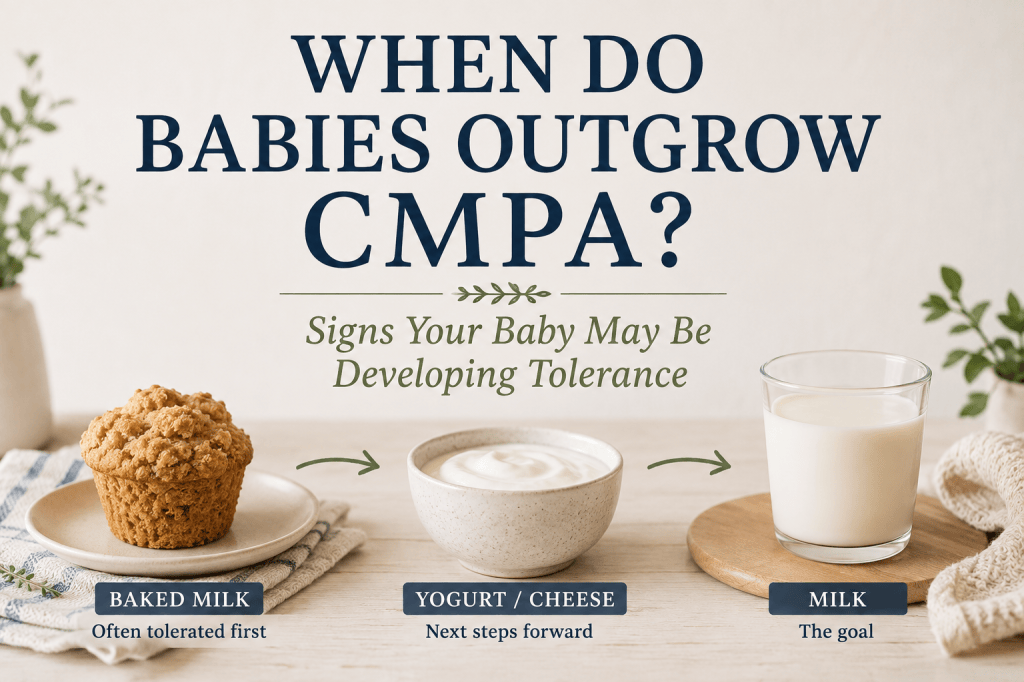
When your baby is first diagnosed with cow’s milk protein allergy, dairy can suddenly feel enormous. You start reading every label. You learn words like whey and casein. Restaurant meals become more complicated. If you’re breastfeeding, your own diet may change. When solids begin, you find yourself checking everything your baby eats too. Eventually, another question starts creeping in: Is this forever? For many children, cow’s milk protein allergy doesn’t last forever. Some develop tolerance during early childhood, although when that happens varies considerably from one child to another and can depend partly on the type of milk allergy they have. That’s why there isn’t one birthday when every child with CMPA should suddenly be handed a glass of milk. Instead, your baby’s healthcare professional may periodically reassess the allergy and eventually recommend an appropriate form of reintroduction or food challenge to determine whether tolerance has developed.
👉 If you’re still in the elimination stage, start with [The Cow’s Milk Protein Allergy Elimination Diet While Breastfeeding: A Complete Step-by-Step Guide].
What Does It Mean to “Outgrow” CMPA?
When people say a child has “outgrown” CMPA, they’re generally talking about the child developing tolerance to cow’s milk protein. In practical terms, that means cow’s milk protein can eventually be consumed without triggering the allergic symptoms that previously occurred. But tolerance isn’t necessarily an all-or-nothing switch that flips overnight. Some children may first tolerate certain extensively heated forms of milk protein while still reacting to less-heated or larger amounts. This is one reason you may hear healthcare professionals discuss things such as baked milk or a milk ladder. Other children may require a medically supervised food challenge before anyone knows whether their allergy has resolved. The appropriate approach depends heavily on the child’s allergy history.
Do Most Babies Eventually Outgrow CMPA?
Many children with cow’s milk allergy eventually develop tolerance, but the timeline varies. You’ll see very specific percentages and ages quoted online, and those numbers can be misleading when they’re presented without context. Studies have involved different groups of children, different definitions of cow’s milk allergy, and different methods of determining whether tolerance developed. What matters more for an individual family is that CMPA during infancy doesn’t automatically mean lifelong milk allergy. Your baby’s pediatrician or allergist can help you understand how their particular presentation affects the likelihood and timing of tolerance.
When Do Babies Usually Outgrow CMPA?
There isn’t one universal age. Some babies and young children develop tolerance relatively early, while others continue reacting to cow’s milk protein for several years. Certain types of non-IgE-mediated cow’s milk allergy often resolve earlier in childhood, while persistent IgE-mediated milk allergy can sometimes last longer. That distinction matters because two parents can both say, “My baby has CMPA,” while their children actually have quite different allergic conditions. One parent’s child may eventually be advised to begin a milk ladder at home. Another may need an allergist-supervised challenge. So if someone in a Facebook group tells you, “My baby grew out of it at 10 months—just try yogurt,” that doesn’t tell you whether yogurt is appropriate for your baby.
Does CMPA Go Away at 6 Months?
Not necessarily. Six months is often a major milestone because babies are beginning complementary foods around this period, but starting solids doesn’t mean CMPA has disappeared. If your baby has been avoiding cow’s milk protein because of diagnosed or suspected CMPA, don’t assume reaching six months means it’s automatically time to introduce dairy. Instead, continue following the avoidance and reassessment plan you’ve been given.
👉 If solids are beginning, read [CMPA and Starting Solids: What Parents Need to Know Before Baby’s First Foods].
Does CMPA Go Away at 12 Months?
Again, not automatically. Some children may be ready for reassessment around this stage depending on their history, while others won’t be. Your child’s first birthday isn’t a universal expiration date for cow’s milk allergy. This becomes particularly important because 12 months is also when parents commonly start thinking about transitioning away from breast milk or infant formula. For a child who still needs to avoid cow’s milk, that transition requires more thought than simply replacing formula or breast milk with ordinary cow’s milk.
👉 Read [What Milk Can a Baby With CMPA Drink? Formula, Breast Milk & Milk Alternatives Explained] if you’re approaching that transition.
How Will I Know If My Baby Is Outgrowing CMPA?
This is where things become frustrating: you usually can’t know for certain simply by looking at your baby. A baby may be thriving, sleeping better, have normal-looking diapers, and show no symptoms precisely because cow’s milk protein has been successfully avoided. That doesn’t prove the allergy has disappeared. Likewise, your baby reaching a certain age without symptoms doesn’t prove tolerance if they haven’t actually been exposed to cow’s milk protein. The real question is what happens when milk protein is appropriately reintroduced—and how that reintroduction should happen depends on your child’s allergy type and reaction history.
Are There Signs That Tolerance May Be Developing?
There may be clues your healthcare professional considers when deciding whether it’s appropriate to reassess the allergy, but parents shouldn’t use a checklist of “outgrown CMPA signs” as permission to test dairy independently. Your child’s age, time since the last reaction, original symptoms, allergy testing when relevant, other allergic conditions, and overall clinical history may all influence the decision. For some children, a healthcare professional may recommend a structured home reintroduction. For others, reassessment may involve an allergist and supervised oral food challenge. The absence of symptoms while dairy-free isn’t itself evidence that the allergy has resolved.
What If My Baby Accidentally Eats Dairy and Nothing Happens?
This is an interesting situation and definitely worth telling your baby’s healthcare professional about. Suppose your baby accidentally eats a food containing milk and you don’t observe the reaction you expected. That could be useful information, but one accidental exposure doesn’t necessarily tell you everything about their current tolerance. The amount eaten may have been small. The milk protein may have been extensively heated. Your child’s previous allergy may have involved delayed symptoms that aren’t immediately obvious. Rather than immediately deciding, “Great! CMPA is gone!” and serving unrestricted dairy, document what your baby ate, approximately how much, and what happened afterward. Then discuss it with their healthcare professional. It may be exactly the information needed to decide whether formal reassessment is appropriate.
What If Accidental Dairy Still Causes Symptoms?
That also provides useful information. If your baby continues to have a consistent reaction after accidental cow’s milk exposure, don’t intentionally keep testing dairy to see whether the next exposure will be different. Continue following your baby’s allergy plan and tell their healthcare professional what happened.
👉 For help after an accidental exposure, read [Why Symptoms Return After Accidental Dairy Exposure: What to Expect].
Does the Type of CMPA Affect When It Goes Away?
Yes, potentially. The term CMPA covers more than one type of immune-mediated reaction to cow’s milk protein. IgE-mediated allergy typically involves reactions that occur relatively quickly after exposure and may be evaluated with allergy testing alongside the child’s clinical history. Non-IgE-mediated cow’s milk allergy can involve delayed gastrointestinal or other symptoms and may be diagnosed differently. There are also specific gastrointestinal food-allergy conditions that require their own medical management. Because these aren’t identical conditions, the expected course and method of reintroduction can differ. That’s why advice like “Just try a little cheese and see what happens” isn’t appropriate for every baby labeled CMPA.
Does a Negative Allergy Test Mean CMPA Is Gone?
Not necessarily. Allergy tests need to be interpreted alongside the child’s clinical history, and not every form of cow’s milk allergy is diagnosed through the same testing. A negative skin-prick or blood test doesn’t automatically rule out every non-IgE-mediated condition. Likewise, a positive test doesn’t independently tell you everything about whether a child will clinically react to a food. Your allergist or pediatrician interprets testing in context rather than using one number as the entire diagnosis.
Why Reassessment Matters
If your child still needs to avoid cow’s milk, continuing avoidance is important. But if they’ve developed tolerance, unnecessary avoidance isn’t beneficial either. A dairy-free diet requires additional label reading, complicates meals and childcare, and can make meeting certain nutritional needs more challenging if replacements aren’t planned appropriately. That’s why CMPA shouldn’t simply be diagnosed during infancy and then forgotten about for years. At some point, there should be a plan for reassessment. The goal isn’t to keep your child dairy-free forever. The goal is to avoid cow’s milk protein while it’s medically necessary—and appropriately determine when it no longer is.
How Do Doctors Know When It’s Time to Try Dairy Again?
There isn’t one age or milestone that automatically means it’s time to reintroduce cow’s milk protein. Instead, your baby’s healthcare professional considers their original reaction, type of CMPA, age, how long they’ve been avoiding milk, whether there have been accidental exposures, and whether other allergic conditions are present. For some children with certain non-IgE-mediated forms of CMPA, a structured home reintroduction may eventually be appropriate. For children with a history of immediate or potentially serious reactions, reassessment may need to happen under the direction of an allergist and sometimes through a supervised oral food challenge. That’s why the question shouldn’t simply be, “Is my baby old enough for dairy?” A better question is, “Based on my baby’s allergy history, how should we find out whether they’ve developed tolerance?”
What Is a Milk Ladder?
A milk ladder is a structured approach that introduces cow’s milk protein in progressively different forms. It commonly begins with milk that has been extensively heated within a baked food and gradually progresses toward less-heated forms of dairy. Heating milk proteins and incorporating them into a baked food can change how allergenic they are. Some children may therefore tolerate certain baked-milk foods before they’re able to tolerate less-heated dairy. The milk ladder isn’t simply: Day 1: cookie. Day 2: cheese. Day 3: glass of milk. There are different milk-ladder protocols, and the appropriate timing and progression depend on the child and the guidance being followed. Most importantly, a milk ladder isn’t appropriate for every type of cow’s milk allergy without medical guidance.
👉 For the complete explanation, read [What Is the Milk Ladder? A Simple Guide for Parents of Babies With CMPA].
Is the Milk Ladder the Same as an Oral Food Challenge?
No.
A milk ladder generally involves progressively introducing different forms or amounts of milk protein according to a structured plan when that approach has been determined to be appropriate. An oral food challenge is a medically controlled procedure used to evaluate whether someone reacts to a suspected allergen. Food is given in measured amounts according to a clinical protocol while the patient is observed. For children with certain allergy histories, an oral food challenge may be the appropriate way to determine whether cow’s milk allergy has resolved. These aren’t interchangeable DIY techniques. Your child’s healthcare professional should determine which approach makes sense based on their particular allergy.
What Is Baked Milk?
“Baked milk” doesn’t simply mean warm milk. It generally refers to cow’s milk protein that has been extensively heated as part of a baked food under specific preparation conditions. Heating can alter milk proteins, which is why some children with milk allergy may tolerate extensively heated milk in baked foods before tolerating less-heated forms. That doesn’t mean any food containing cooked dairy counts as the first step of a milk ladder. Pizza cheese, macaroni and cheese, butter on toast, pancakes, and a muffin baked according to a specific milk-ladder recipe aren’t allergically equivalent simply because they’ve all been heated. If your child has been given a milk-ladder plan, follow the preparation and portion instructions that accompany that specific plan.
If My Baby Can Eat Baked Milk, Does That Mean CMPA Is Gone?
Not necessarily. Tolerating extensively heated milk can be an important milestone, but it doesn’t automatically mean your child can tolerate yogurt, cheese, fresh cow’s milk, or every other form of dairy. Think of tolerance as something that may develop in stages for some children. A child might tolerate one form of milk protein but react when they progress to a less-heated form or a larger amount. That’s one reason structured reintroduction exists. Passing one step means your child tolerated that step. Follow your healthcare professional’s guidance before assuming all dairy is now safe.
What Happens If My Baby Passes One Step but Reacts to the Next?
Don’t treat it like failure. It may simply mean your child currently tolerates the amount or form of milk protein at the earlier stage but isn’t ready for the next one. Follow the instructions you’ve been given for what to do if symptoms occur. Depending on the child’s history and protocol, their healthcare professional may advise returning to a previously tolerated stage, pausing progression, or reassessing the plan. What you shouldn’t do is repeatedly push through symptoms because you think the baby needs to “get used to” the food. A milk ladder isn’t a contest to reach cow’s milk as quickly as possible.
Should I Rush Through the Milk Ladder If My Baby Is Doing Well?
No.
If a structured reintroduction plan specifies how long to remain at each stage or how progression should occur, follow that plan. The goal isn’t to finish the ladder. The goal is to determine what your child currently tolerates safely. Rushing introduces unnecessary uncertainty. If symptoms appear after you’ve jumped through several stages quickly, it can also become harder to know which form or amount caused the problem.
Can I Just Give My Baby a Tiny Amount of Dairy to Test It?
Not without knowing whether home reintroduction is appropriate for your baby’s allergy history. “Tiny amount” sounds harmless, but the amount needed to trigger an allergic reaction isn’t something parents can reliably predict. This is especially important for children who have had immediate reactions or symptoms suggesting a potentially serious IgE-mediated allergy. Reintroduction for those children may require specialist guidance and a medically supervised challenge. Don’t use an accidental exposure that went well as permission to design your own challenge.
Can I Eat Dairy First While Breastfeeding to Test Whether My Baby Is Better?
This is a particularly understandable question for breastfeeding parents. If your baby’s original symptoms occurred through breastfeeding while you were consuming dairy, their healthcare professional may sometimes provide a specific maternal reintroduction plan as part of confirming or reassessing the diagnosis. But eating dairy yourself and directly feeding dairy to your baby are not equivalent exposures. The amount and route of cow’s milk protein exposure differ. So don’t assume that because your baby didn’t react when you ate cheese, they’re automatically ready to eat cheese themselves. Likewise, don’t invent your own maternal challenge if you’ve been advised to continue strict elimination. Ask how your baby’s diagnosis should actually be reassessed.
What If I’ve Already Accidentally Eaten Dairy and My Baby Was Fine?
Tell your baby’s healthcare professional. An accidental exposure without symptoms may be encouraging, particularly if previous symptoms were associated with maternal dairy consumption. But it doesn’t necessarily prove that unrestricted dairy is appropriate. What you ate, how much you ate, how your baby was exposed, and the baby’s original type of reaction all matter. Instead of thinking of an accidental exposure as a failed elimination, think of it as another piece of information.
What If My Baby Accidentally Ate Dairy and Was Fine?
This can be even more informative because the baby directly consumed the food—but the details still matter. Was it a tiny amount of milk baked into a muffin? A bite of cheese? Yogurt? A food with butter? How much did your baby actually eat? How extensively was the milk heated? How long did you observe them afterward? Write those details down and tell their healthcare professional. That information may influence whether formal reintroduction is appropriate, but it shouldn’t automatically become permission to offer unrestricted dairy.
What Does Successfully Developing Tolerance Look Like?
Ultimately, tolerance means your child can consume the relevant cow’s milk protein without experiencing the allergic reaction that previously required avoidance.
But getting there may look different between children. For one child, a supervised oral food challenge may demonstrate that milk allergy has resolved. Another may gradually progress through a milk ladder. Another may tolerate baked milk for a period while still needing to avoid less-heated dairy. The process isn’t necessarily linear. That’s why comparing your baby’s progress with another CMPA baby online isn’t particularly useful.
Does Tolerating Dairy Once Mean We’re Done?
One successful exposure is encouraging, but follow the plan you’ve been given. In some situations, healthcare professionals may recommend that a tolerated food continue to be included regularly in the diet. The exact frequency and amount depend on the child and the reintroduction protocol. Don’t independently decide that your child needs daily dairy to “keep the tolerance” or, conversely, successfully introduce dairy and then avoid it for another six months because you’re nervous. Ask what continued consumption should look like after a successful reintroduction.
Can CMPA Come Back After My Baby Outgrows It?
If your child has genuinely developed tolerance, the expectation isn’t that CMPA will simply switch on and off every few weeks. However, new symptoms after dairy should still be evaluated based on what’s actually happening rather than automatically assuming the old allergy has returned. Children can develop gastrointestinal symptoms, rashes, illnesses, and other problems for many reasons. If symptoms consistently occur again with cow’s milk exposure, contact your child’s healthcare professional rather than repeatedly removing and reintroducing dairy yourself.
What About Babies With IgE-Mediated Milk Allergy?
This is where generic online CMPA advice can become particularly problematic. If your baby has an IgE-mediated cow’s milk allergy—especially with a history of rapid or potentially serious reactions—don’t assume a home milk ladder is appropriate simply because another CMPA parent used one. Your child’s allergist may use their reaction history, testing, time since the last reaction, and other clinical information to determine when reassessment is appropriate. A supervised oral food challenge may be recommended. Follow the allergy action plan you’ve been given and don’t intentionally expose your child to cow’s milk protein outside that plan.
What About Non-IgE CMPA?
Some children with non-IgE-mediated cow’s milk allergy may eventually be advised to use a structured home reintroduction approach such as a milk ladder. Because symptoms can be delayed, monitoring can look different from the immediate reactions associated with IgE-mediated allergy. Again, “non-IgE” doesn’t mean parents should automatically begin a milk ladder whenever they feel ready. The diagnosis, original symptoms, child’s health, and appropriate timing still need to be considered.
Why Not Just Keep Dairy Out If the Diet Is Working?
Because avoiding a food unnecessarily isn’t the goal of food-allergy management.
If your child still has CMPA, avoidance protects them from reactions and remains important. But once tolerance develops, unnecessarily continuing strict dairy avoidance can make feeding more complicated and may restrict useful food choices and nutrients. There’s also a psychological side to this. After months of checking every label and worrying about exposure, reintroducing the food can feel much scarier than eliminating it did. That’s understandable. But the solution isn’t indefinite avoidance because testing tolerance feels frightening. It’s having an appropriate reassessment plan so you know when, where, and how cow’s milk should eventually be tried.
The Goal Isn’t Dairy-Free Forever
When CMPA becomes part of everyday life, dairy-free can start feeling like your baby’s permanent identity. But that’s not what we’re trying to create. We’re trying to protect your baby while cow’s milk protein causes a problem, provide adequate nutrition while it’s avoided, and periodically reassess whether that restriction is still necessary. If your baby eventually develops tolerance, that’s a success. If they aren’t ready yet, that’s useful information too.
There is no prize for reaching the top of the milk ladder first. The right timeline is the one that’s appropriate for your child.
Things That Don’t Necessarily Mean Your Baby Has Outgrown CMPA
When you’ve spent months waiting for tolerance, it’s easy to interpret every improvement as a sign that the allergy is disappearing. But several things that seem encouraging don’t actually confirm tolerance on their own. Your baby having normal-looking diapers while dairy-free doesn’t prove CMPA is gone. Neither does improved reflux, clearer skin, better sleep, or several months without symptoms. Those changes may simply mean the elimination is working. Likewise, your baby turning one isn’t proof that CMPA has resolved. Neither is successfully eating a food labeled “may contain milk,” because precautionary allergen labeling is different from intentionally consuming a known amount of cow’s milk protein. The strongest evidence comes from appropriately reintroducing cow’s milk protein and demonstrating that it can be tolerated, using the approach recommended for your child’s allergy history.
What Might CMPA Look Like Around the First Birthday?
The first birthday can feel like a major CMPA milestone because feeding changes so much around this time. Your baby is eating more family foods, breast milk or formula may play a different role, and other children may be transitioning to cow’s milk. But a child with CMPA needs an individualized plan. If your child still needs to avoid cow’s milk, talk with their healthcare professional about nutrition and what should replace the role cow’s milk might otherwise play. Don’t simply choose the first oat, almond, coconut, or other plant beverage on the shelf. Protein, calories, fat, calcium, vitamin D, iodine, vitamin B12, and the rest of the child’s diet can all matter when choosing an alternative.
What About CMPA at 18 Months or 2 Years?
A child who still has CMPA beyond infancy hasn’t necessarily done anything unusual or concerning. Some children simply develop tolerance later than others. What becomes increasingly important is making sure the allergy isn’t being treated as a permanent restriction without reassessment. If your toddler has been avoiding cow’s milk for a long period, ask their pediatrician or allergist: Do we still need complete avoidance? When should tolerance be reassessed? Would a milk ladder be appropriate for my child? Would an oral food challenge be more appropriate? Does my child’s current diet adequately replace the nutrients they’re missing from dairy? Those questions are much more useful than comparing your child’s age with someone else’s CMPA timeline online.
What If My Child Is 3 and Still Has CMPA?
Some children continue to have cow’s milk allergy beyond the toddler years, particularly certain children with IgE-mediated allergy. At this stage, ongoing allergist follow-up may become especially important. Your child’s healthcare team can evaluate whether there are signs that tolerance may be developing and determine when another challenge or reassessment is appropriate. Nutritional adequacy also matters as dairy avoidance continues. A pediatric dietitian can help if your child’s diet is limited, they’re avoiding several allergens, you’re struggling to find suitable replacements, or there are concerns about growth or nutrient intake. The important thing isn’t whether your child matches an average age. It’s whether their allergy is being actively managed and periodically reassessed.
What Should I Ask at Our Next Appointment?
You don’t need to walk into the pediatrician or allergist appointment simply asking, “Has my baby outgrown it?” More specific questions can get you much more useful answers. You might ask: What type of cow’s milk allergy do you think my child has?
Based on their original reaction, when would you normally reassess tolerance? Is home reintroduction appropriate, or should this happen under medical supervision? Would you recommend a milk ladder for my child? If so, which milk ladder should we follow? What should we do if symptoms occur at one of the steps? If my child passes reintroduction, how regularly should dairy remain in their diet? Are there any nutritional concerns while we’re still dairy-free? Those questions turn a vague conversation about “maybe trying dairy someday” into an actual plan.
A Simple CMPA Reassessment Checklist
Before attempting any dairy reintroduction, make sure you can answer a few basic questions. Do you know why your child was diagnosed with CMPA? Do you know what their previous reactions looked like? Has their healthcare professional said it’s time to reassess? Do you know whether the reintroduction should happen at home or in a medical setting? Do you know exactly what food and amount you’re supposed to use? And do you know what you’re supposed to do if symptoms occur? If you don’t know those answers, get them before experimenting. Reintroduction should give you useful information—not create more uncertainty.
What If I’m Terrified to Try Dairy Again?
This part doesn’t get discussed enough.
After months of avoiding cow’s milk protein, checking labels, worrying about accidental exposures, and finally getting your baby’s symptoms under control, deliberately giving them dairy can feel completely backwards. You spent all this time learning: Milk = problem. Now someone is telling you it may be time to try milk again. Being nervous about that transition is understandable, especially if you’ve previously watched your child have a significant reaction. The solution isn’t to force yourself into an unsupervised home challenge you’re uncomfortable with. Tell your baby’s healthcare professional you’re worried. Ask exactly why they believe reintroduction is appropriate, what symptoms you’re monitoring for, and whether the setting matches your child’s reaction history. A clear plan makes the process much less uncertain.
Frequently Asked Questions About Outgrowing CMPA
What Age Do Most Babies Outgrow CMPA?
There isn’t one age when CMPA reliably disappears. Many children eventually develop tolerance during childhood, but timing varies considerably depending on the child and the type of cow’s milk allergy. Your child’s healthcare professional can give you a more meaningful assessment based on their individual history than a general age found online.
Can a Baby Outgrow CMPA Before 1 Year?
Some babies may develop tolerance relatively early, but reaching a certain age isn’t enough to know that the allergy has resolved. Reassessment should follow an approach appropriate for the baby’s original reaction and allergy type.
Can CMPA Last Past 1 Year?
Yes. Some children continue to react to cow’s milk protein after their first birthday. That doesn’t mean the allergy will necessarily be lifelong. Continue avoidance as recommended while maintaining an appropriate plan for nutritional support and future reassessment.
Can CMPA Last Until Age 2?
Yes. Some children remain allergic to cow’s milk at age two and beyond. The expected timeline varies, particularly between different types of cow’s milk allergy. If your child has been dairy-free for an extended period, make sure their healthcare professional is periodically reassessing whether avoidance remains necessary.
Can CMPA Be Lifelong?
Cow’s milk allergy can persist in some people, particularly certain cases of IgE-mediated allergy, although many children develop tolerance during childhood. A child’s individual allergy history is much more useful than assuming either that CMPA will definitely disappear quickly or that it will definitely last forever.
Does Better Poop Mean My Baby Has Outgrown CMPA?
No. Improved stool while avoiding dairy may mean the elimination is working. It doesn’t demonstrate that your baby can now tolerate cow’s milk protein.
Does Improved Reflux Mean CMPA Is Gone?
Not necessarily. Reflux can improve as babies mature, and symptoms improving while cow’s milk remains excluded doesn’t prove tolerance.
Can My Baby Outgrow CMPA While I’m Still Breastfeeding?
Potentially, yes. Development of tolerance isn’t dependent on stopping breastfeeding. If you’ve been avoiding dairy yourself because of your baby’s CMPA, discuss with their healthcare professional when and how your own diet and your baby’s cow’s milk avoidance should be reassessed.
If My Baby Accidentally Had Dairy With No Reaction, Has CMPA Gone Away?
Maybe tolerance is developing, but one accidental exposure isn’t enough to make that conclusion confidently. The amount and form of dairy matter. Write down what your baby ate and what happened, then discuss it with their healthcare professional. It may be a good reason to consider formal reassessment.
If My Baby Tolerates Baked Milk, Can They Have Cheese?
Not automatically. Some children can tolerate extensively heated milk protein before they tolerate less-heated forms of dairy. Follow the progression recommended by your child’s healthcare professional rather than jumping from one successfully tolerated form to unrestricted dairy.
When Should We Start the Milk Ladder?
There isn’t a universal age. A milk ladder should be used when a qualified healthcare professional determines that this type of reintroduction is appropriate for your child’s allergy history.
👉 Read [What Is the Milk Ladder? A Simple Guide for Parents of Babies With CMPA] for more information.
What Happens If My Baby Fails the Milk Ladder?
Try not to think of it as “failing.” A reaction may simply indicate that your child isn’t currently ready for that particular form or amount of cow’s milk protein. Stop progressing and follow the instructions provided with your child’s reintroduction plan. Their healthcare professional can determine when another attempt may be appropriate.
Should I Keep Giving Dairy Once My Child Tolerates It?
Ask your child’s healthcare professional what continued intake should look like after successful reintroduction. Depending on the situation, they may recommend keeping tolerated dairy in the diet regularly rather than introducing it once and then avoiding it again. Don’t invent your own frequency or amount when you’ve been following an allergy-management plan.
Your Baby’s CMPA Timeline Is Their Own
CMPA communities can be incredibly useful, but they can also create unrealistic expectations. One parent says their baby was completely dairy-tolerant before the first birthday. Another says their three-year-old still can’t tolerate milk. Someone else’s baby reached step six of a milk ladder and then had symptoms. Another child went through a supervised challenge and passed Those stories can all be true. They still don’t tell you what will happen with your child. Use other families for support—not as the medical timetable for your baby’s allergy.
Final Thoughts
So, when do babies outgrow CMPA? There isn’t one universal answer. Many children eventually develop tolerance to cow’s milk protein, but the timing varies depending on the child and the type of cow’s milk allergy involved. Some may tolerate certain baked forms of milk before other dairy products, while others may require specialist reassessment or a supervised oral food challenge.
The absence of symptoms while your baby is dairy-free doesn’t prove that CMPA has resolved. Neither does reaching six months, one year, or another particular birthday.
What matters is appropriate reassessment. Ask your baby’s healthcare professional when tolerance should be evaluated, whether home reintroduction is appropriate, whether a milk ladder makes sense, and what to do if symptoms return. And remember why you’re doing all of this. The objective isn’t to keep your child dairy-free forever. It’s to keep cow’s milk protein out while it causes a problem, provide a nutritionally adequate diet in the meantime, and safely recognize when your child no longer needs that restriction. Your baby’s CMPA journey may last months or years. But for many families, dairy avoidance is a chapter—not the entire story.
You May Also Enjoy
👉 What Is the Milk Ladder? A Simple Guide for Parents of Babies With CMPA
👉 When Can I Try Dairy Again While Breastfeeding? What Moms Need to Know About Reintroduction
👉 Why Symptoms Return After Accidental Dairy Exposure: What to Expect
👉 Baby Still Has CMPA Symptoms After Cutting Dairy? Here’s What to Check Next
👉 What Milk Can a Baby With CMPA Drink? Formula, Breast Milk & Milk Alternatives Explained
👉 CMPA and Starting Solids: What Parents Need to Know Before Baby’s First Foods
👉 The Cow’s Milk Protein Allergy Elimination Diet While Breastfeeding: A Complete Step-by-Step Guide
Medical Disclaimer
The information in this article is intended for educational and informational purposes only and isn’t a substitute for individualized medical, allergy, nutritional, or feeding advice. Cow’s milk protein allergy includes different types of immune-mediated reactions, and the appropriate timing, location, and method of reintroduction depend on the child’s diagnosis, previous reactions, age, medical history, and other risk factors. Do not intentionally reintroduce cow’s milk protein to a baby or child with a diagnosed or suspected cow’s milk allergy unless their pediatrician, allergist, dietitian, or another qualified healthcare professional has determined that reintroduction is appropriate and explained how it should be performed. A home milk ladder isn’t appropriate for every child, particularly those with certain histories of immediate or potentially serious allergic reactions. Seek urgent medical care for potentially serious or rapidly developing allergic symptoms. Never delay or disregard professional medical advice because of information you have read on this website.






Leave a comment